
New Hampshire NH DMV Permit Practice Test 7
Test 7 of 10. Pick an answer for each question to see if it is right and why; your score appears at the end. You need 32 correct answers to pass, the same ratio as the real New Hampshire test.
- Questions40
- Correct to pass32
- Passing score80%
- Minimum age16 years
-
1. What is worth carrying in the vehicle during a winter trip?
Show answer
Answer A: A blanket, a flashlight, a scraper and a small shovel
A winter kit keeps you warm and visible if you are stopped for hours, and lets you clear glass and dig the wheels out. Hot water can crack cold glass.
-
2. The vehicle ahead of you has pulled out to pass a truck. May you follow it out and pass as well?
Show answer
Answer B: No, wait until it is done and judge the road for yourself
You cannot see past the vehicle ahead of you, and if it has to abort the pass there is nowhere for either of you to go.
-
3. You are approaching a refuse collection truck working along your street. What should you expect?
Show answer
Answer D: Workers stepping into the road around the truck
Collection crews move constantly between the truck and the curb, often from where you cannot see them, so slow right down and pass only when the whole area is clear.
-
4. How does a posted school zone speed limit work in New Hampshire?
Show answer
Answer B: It is 10 mph below the usual posted limit, from 45 minutes before school opening until opening, and from closing until 45 minutes after closing
In a posted New Hampshire school zone the limit drops 10 mph below the usual posted limit for the 45 minutes before school opens and the 45 minutes after it closes.
-
5. Two left-turn lanes are available and you must turn right again a short distance after the turn. Which of the two should you use?
Show answer
Answer D: The right one, so you finish nearer the right side of the new street
Each turn lane feeds the matching lane of the new street, so choosing the right-hand of the two left-turn lanes leaves you closer to the side you will need.
-
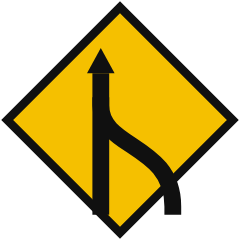
6. What is the safest way to deal with the situation this sign announces?
Show answer
Answer B: Match the speed of the other traffic stream and open a gap so vehicles can blend without hard braking
Blending works when speeds are matched and gaps are opened, so nobody has to brake hard or swerve where the two streams come together.
-
7. An exit ramp is separated from the highway by a triangle of pavement painted with white stripes. What may you do there?
Show answer
Answer C: Nothing; keep off it and choose either the lane or the ramp
The striped area between a ramp and the through lanes is not for driving, stopping or last-second changes of direction.
-
8. After a crash, what information should you exchange with the other driver?
Show answer
Answer B: Name, address, driver license, vehicle registration and insurance details
Identification, registration and insurance information are what the other party and the insurers need. Sensitive financial details are never required.
-
9. A 19-year-old holds a New Hampshire youth operator license. Which statement about the restrictions is correct?
Show answer
Answer A: The night and passenger restrictions no longer apply to this driver
RSA 263:14 states that the night and passenger restrictions on a youth operator license do not apply to drivers who are over 18, even though the license itself runs until 21.
-
10. Which combination best reduces the chance of hydroplaning?
Show answer
Answer D: Good tread depth, correct tire pressure and lower speed in the rain
Tread channels water away, correct pressure keeps the tire's shape, and lower speed gives the tire time to push water aside. Hydroplaning can begin at surprisingly modest speeds.
-
11. Under New Hampshire law, when may a driver take turn-by-turn directions from the screen of a navigation application?
Show answer
Answer D: Only when the device is integrated into the vehicle or mounted on the dashboard, windshield or visor
RSA 265:79-c allows turn-by-turn information from a screen only where the device is integrated into the vehicle or mounted on the dashboard, windshield or visor, while spoken routing information may come from any hands-free device.
-
12. Four vehicles reach a four-way stop from all four directions at the same instant. How is the deadlock resolved?
Show answer
Answer C: Each driver yields to the vehicle on the right and they go one by one
Yielding to the right applies to every driver, so the group untangles itself as drivers take turns rather than moving together.
-
13. Which New Hampshire convictions force a driver to file proof of insurance on an SR-22 certificate?
Show answer
Answer D: Driving while intoxicated, leaving the scene or conduct after an accident, and a second reckless operation offense
The NH DMV lists driving while intoxicated, leaving the scene or conduct after an accident, and a second reckless operation conviction among the offenses that require an SR-22 filing.
-
14. You are stopped at a red light waiting to turn right where the turn is allowed. Besides traffic from the left, what must you check?
Show answer
Answer D: Both crosswalks, and anyone approaching along your right side
A right turn on red crosses the crosswalk in front of you and enters the one on the cross street, and cyclists often approach along your right.
-
15. When does an ordinary New Hampshire driver license expire?
Show answer
Answer C: On the fifth anniversary of the holder's date of birth following issuance
RSA 263:10 expires a driver license on the fifth anniversary of the holder's date of birth following the date of issuance.
-
16. You are stopped inside an intersection waiting for a gap to turn left. How should your front wheels be positioned?
Show answer
Answer C: Pointing straight ahead until you actually begin the turn
If your wheels are already turned left and another vehicle strikes you from behind, you would be pushed into oncoming traffic.
-
17. A small plate under a stop sign reads CROSS TRAFFIC DOES NOT STOP. What is it telling you?
Show answer
Answer D: Traffic on the cross street is not required to stop at all
The plate warns that the other road is uncontrolled, so you must wait for a gap instead of expecting anyone to take turns with you.
-
18. A bicyclist is riding in the middle of a narrow travel lane ahead of you. What is the correct response?
Show answer
Answer D: Slow down and wait until you can pass with wide clearance, changing lanes if needed
A bicyclist has the same right to use the lane as a driver, and a narrow lane may not leave safe passing room, so wait for a gap that lets you move over and pass with a wide margin.
-
19. You carry reflective warning triangles in your car. How should they be used after a breakdown?
Show answer
Answer B: Set out behind the vehicle, far enough back to warn traffic before it arrives
A warning device works only if drivers see it in time to react, so it is placed well back along the road they are traveling.
-
20. What alcohol concentrations are evidence of impaired driving in New Hampshire?
Show answer
Answer D: .08 percent or higher for drivers 21 and over, and .02 percent or higher for drivers under 21
New Hampshire treats a blood alcohol concentration of .08 percent or higher as legal intoxication, and applies a .02 percent limit to drivers under 21.
-
21. Which of these is part of preparing a vehicle for winter driving?
Show answer
Answer A: Fitting good tires and using washer fluid that will not freeze
Winter readiness means tread, battery, wipers, antifreeze and washer fluid rated for the cold, plus a reasonable amount of fuel in the tank.
-
22. How many demerit points in one calendar year lead to a suspension for a New Hampshire driver aged 21 or older?
Show answer
Answer A: 12 points
New Hampshire suspends a driver aged 21 or older for up to three months after 12 demerit points in one calendar year; the thresholds are 18 points in two years and 24 points in three years.
-
23. How much clearance does New Hampshire presume reasonable when a vehicle passes a bicycle at 30 mph or less?
Show answer
Answer A: 3 feet, with one more foot for every 10 mph above 30
RSA 265:143-a presumes a passing distance reasonable and prudent if it is at least 3 feet at 30 miles per hour or less, with one additional foot of clearance for every 10 miles per hour above that.
-
24. How closely may a New Hampshire driver follow fire apparatus that is responding to an alarm?
Show answer
Answer B: No closer than 500 feet
RSA 265:100 bars a driver who is not on official business from following responding fire apparatus closer than 500 feet, or from parking within the block where it has stopped.
-
25. What should you do as you approach your exit from a roundabout?
Show answer
Answer A: Signal right and check the crosswalk for pedestrians before leaving
A right signal tells following drivers and waiting drivers that you are leaving, and pedestrians cross at the exit leg, so the crosswalk must be checked.
-
26. A traffic signal is displaying a flashing red light. How must you treat it?
Show answer
Answer D: Stop completely, then proceed when the way is clear
A flashing red carries the same meaning as a stop sign: come to a full stop, then go only when it is safe.
-
27. What does a New Hampshire applicant receive at the counter when a driver license is renewed in person?
Show answer
Answer B: A 60-day temporary paper license, with the permanent card mailed to the holder
The NH DMV issues a 60-day temporary paper license at renewal and mails the permanent card to the holder's New Hampshire mailing address within 60 days.
-
28. Besides the night and passenger rules, what limit does New Hampshire place on the holder of a youth operator license?
Show answer
Answer B: The number of occupants may not exceed the number of safety restraints
RSA 263:14 forbids the holder of a youth operator license to drive when the number of occupants exceeds the number of safety restraints in the vehicle.
-
29. Which statement best describes what the basic speed law requires of you?
Show answer
Answer C: That you never drive faster than is reasonable and safe for the conditions
Nearly every state has a basic speed law that makes the conditions the real limit: weather, traffic, light and road surface can all require a speed well below the posted number.
-
30. A sign with a brown background and a white legend guides road users to
Show answer
Answer B: parks, campgrounds and other recreational or cultural sites
Brown is reserved for recreational and cultural interest area signing, such as parks, historic sites and scenic areas.
-
31. Is it a good idea to shift into neutral and coast down a long hill to save fuel?
Show answer
Answer B: No, you lose engine braking and some control of the vehicle
In neutral the engine cannot help slow the vehicle, so the brakes do all the work and can overheat. Stay in gear so the drivetrain helps hold your speed.
-
32. Loose items slide around your car and rattle every time you brake. What is the answer?
Show answer
Answer C: Secure them before you start driving
Sliding objects pull your attention and can roll under the pedals, so stow them in the trunk or wedge them before the trip rather than chasing them during it.
-
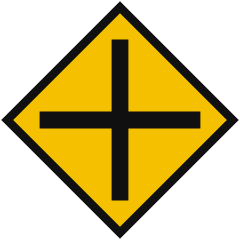
33. What should a driver expect a short distance beyond this sign?
Show answer
Answer C: Another road crossing the one being traveled
Traffic may enter or cross from either side at the intersection ahead, so the driver should ease off, cover the brake and check both approaches.
-
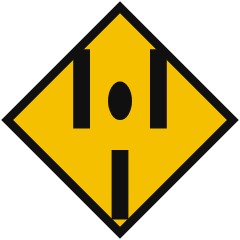
34. What must a driver be ready for beyond this sign?
Show answer
Answer C: Vehicles approaching from the opposite direction in the next lane over
The separation between the two directions runs out, so from that point oncoming vehicles share the same pavement and the driver has to keep right.
-
35. You are turning left from a two-way street onto another two-way street. Where should you begin and end the turn?
Show answer
Answer B: Begin in the lane just right of the center line and finish just right of the center line of the new street
You approach a left turn from the lane closest to the center line and enter the new roadway just to the right of its center line, which keeps you clear of oncoming traffic.
-
36. What is the benefit of looking far down the road rather than just ahead of the hood?
Show answer
Answer A: You steer with smaller corrections and you see trouble in plenty of time
A distant view steadies your steering and gives you time to plan, because you meet hazards after you have already seen them.
-
37. You leave a brightly lit service area onto a dark rural road. Why should you slow down for a while?
Show answer
Answer C: Your eyes need time to adjust, so at first you see less
Eyes take a few minutes to adapt from bright light to darkness, and during that time you can see much less than your headlights actually show.
-
38. You are in the right-hand of two left-turn lanes and the vehicle beside you starts to drift toward your lane during the turn. What should you do?
Show answer
Answer B: Slow slightly, keep to your own lane and give the other vehicle room
Drivers commonly drift wide in dual turn lanes, so hold your own line, ease off and leave space rather than racing or crowding the other vehicle.
-
39. A driver is following you far too closely. What is the best response?
Show answer
Answer D: Increase your own following distance and let the driver pass when it is safe
More room ahead of you means you can slow gradually instead of braking hard, which reduces the chance of being struck from behind, and letting the driver by removes the problem entirely.
-
40. A blue motorist service sign showing a fuel symbol and an arrow means that
Show answer
Answer D: fuel is available in the direction shown, and the sign imposes no obligation
Service signs are informational: they tell the driver what is available and in which direction, but they create no requirement.