
New Hampshire NH DMV Permit Practice Test 3
Test 3 of 10. Pick an answer for each question to see if it is right and why; your score appears at the end. You need 32 correct answers to pass, the same ratio as the real New Hampshire test.
- Questions40
- Correct to pass32
- Passing score80%
- Minimum age16 years
-
1. How does a person practice driving in New Hampshire before getting a license?
Show answer
Answer A: New Hampshire issues no car learner permits; a person at least 15 and a half may drive accompanied by a parent, guardian or licensed adult aged 25 or older
New Hampshire does not issue learner permits for cars; state law lets a person at least 15 and a half practice while accompanied by a parent, legal guardian or a licensed responsible adult aged 25 or older.
-
2. The hood of your vehicle flies open while you are driving and blocks your view. What should you do?
Show answer
Answer A: Look through the gap beneath the hood or out the side window, slow down and pull off the road
You usually still have a narrow view under the raised hood or through the side window. Use it to steer, slow gradually and get clear of traffic before securing the hood.
-
3. A rectangular marker with alternating black and retroreflective yellow stripes set at a slant is used to
Show answer
Answer C: mark an obstruction, with the stripes sloping down toward the side on which traffic should pass
This striped panel is an object marker, and the direction in which the stripes slope shows the driver which side of the obstruction to pass on.
-
4. The vehicle you want to pass is traveling close to the speed limit. What should you do?
Show answer
Answer C: Stay behind, because a pass may not take you over the limit
The speed limit applies while passing too. If you cannot complete the pass without exceeding it, do not start the pass.
-
5. What effect does completing an approved New Hampshire driver improvement program have on demerit points?
Show answer
Answer D: It cuts 3 points from the most recent point total for suspension purposes, though the points stay on the record
For a driver with at least three demerit points, proof of completing an approved driver improvement program reduces the most recent assessment total by three points for suspension purposes, although the points remain on the record report.
-
6. A deer suddenly steps onto the road ahead of you at night. What is the safest response?
Show answer
Answer C: Brake firmly and stay in your lane rather than swerving
Swerving at speed often leads to a rollover or a head-on crash that is far worse than hitting the animal. Brake hard, hold your lane and expect more deer to follow.
-
7. A bicyclist stops at a four-way stop just before you do. Who goes first?
Show answer
Answer B: The bicyclist, who reached the intersection and stopped there before you did
A bicyclist on the roadway follows the same right of way rules as a driver, so arrival order decides the turn.
-
8. A school sign paired with a plaque showing a diagonal downward-pointing arrow is installed
Show answer
Answer D: at the school crossing itself, or as close to it as possible
The diagonal downward arrow points at the crossing, so this assembly is placed at the crossing location rather than in advance of it.
-
9. It is cold and the road looks wet, but you notice the tires of vehicles ahead are throwing up no spray. What does this suggest?
Show answer
Answer B: The surface has frozen and is probably icy
Water throws spray, but ice does not. A shiny road with no spray in freezing temperatures is a strong sign of black ice, so slow down and avoid sudden inputs.
-
10. You have started to pass and you see the no-passing zone beginning ahead. What should you do?
Show answer
Answer D: Ease off, drop back and return to your own lane
A pass must be completed before the no-passing zone starts. If it will not fit, abandon it and slot back in behind.
-
11. How does heavy cargo on a roof rack change the way a vehicle handles?
Show answer
Answer D: It raises the center of gravity, so the vehicle tips more in turns and needs gentler steering
Weight carried high makes the vehicle lean more and roll over more easily, and extra weight lengthens stopping distance. Drive slower and steer smoothly with a loaded roof.
-
12. You realize you have turned the wrong way onto a one-way street. What should you do?
Show answer
Answer A: Pull to the right, stop, and back into the street you came from when clear
Get out of the traffic stream first: pull right and stop, then back out into the street you came from once you can see it is safe.
-
13. Does New Hampshire require a driver to carry liability insurance?
Show answer
Answer B: No, the state has no mandatory insurance law, but an uninsured driver is liable for all damages and may be suspended until a settlement is reached
New Hampshire has no mandatory automobile insurance law, but an uninsured driver in a crash is responsible for all property damage and medical costs, and the DMV must suspend driving privileges until a settlement is reached.
-
14. At what alcohol concentration does a New Hampshire driver commit aggravated driving while intoxicated on that figure alone?
Show answer
Answer D: 0.16 or more
RSA 265-A:3 makes an alcohol concentration of 0.16 or more aggravated driving while intoxicated without any additional circumstance.
-
15. A driver who is passing you cannot complete the pass because a vehicle is coming. What should you do?
Show answer
Answer C: Ease off the accelerator and make room for them to drop back in
The only place for the passing vehicle to go is the gap behind you, and easing off opens that gap immediately.
-
16. How should your speed behave while you move from one lane into the next?
Show answer
Answer C: Keep it steady or adjust it smoothly to match the traffic in the new lane
A lane change works best as a smooth movement at the speed of the lane you are joining, since sudden braking or acceleration surprises the drivers around you.
-
17. A New Hampshire vehicle is parked partly on a way at night under a street light that leaves it plainly visible. What does the parking light rule require?
Show answer
Answer B: No parking lights, because the vehicle is plainly visible from other lighting
RSA 265:112 requires parking lights on vehicles parked wholly or partly on a way from half an hour after sunset to half an hour before sunrise and whenever rain, snow or fog interferes with clear vision, unless the vehicle is plainly visible because of street or other lights.
-
18. A driver extends the left arm out the window and bends it upward at the elbow. What does this signal mean?
Show answer
Answer B: A right turn
The left arm bent upward at the elbow is the standard hand signal for a right turn.
-
19. If you must abandon a vehicle stuck on the tracks with a train coming, why do you move toward the train and away at an angle?
Show answer
Answer D: Because debris from the impact is thrown forward, away from the train
A train pushes wreckage down the track ahead of it, so walking toward the train and off to the side keeps you out of the debris path.
-
20. Why are pedestrians and cyclists a special risk on unlit streets at night?
Show answer
Answer A: Dark clothing can make them invisible until they are very close
A person in dark clothing reflects almost no light and may not appear until they are inside your stopping distance, so cut your speed where people may be about.
-
21. A sign at the intersection prohibits U-turns, but the opening looks wide and clear. What may you do?
Show answer
Answer B: Obey the sign and turn around somewhere else
A prohibition applies whatever the traffic looks like at that moment, usually because of sight distance or conflicts you cannot see from the lane.
-
22. You have fitted the small temporary spare tire after a flat. What should you keep in mind?
Show answer
Answer C: It is meant for low speed and short distances until the regular tire is repaired
Compact spares have limited grip, handling and durability. Follow the speed and distance limits printed on the tire and get the regular tire fixed soon.
-
23. A signal beside a fire station stays dark until apparatus is about to leave, when it shows yellow and then red. What must a driver do?
Show answer
Answer B: Stop on the red and wait until the signal goes dark again
An emergency vehicle signal is a real traffic signal, so its red indication must be obeyed while the apparatus pulls out into the street.
-
24. A New Hampshire policyholder buys liability limits above the statutory minimum. What happens to the uninsured motorist coverage?
Show answer
Answer A: It automatically becomes equal to the liability limits chosen
RSA 264:15 makes uninsured motorist coverage automatically equal in amounts and limits to the liability coverage the insured elects when that coverage exceeds the statutory minimum.
-
25. When must a New Hampshire driver file a crash report with the Division of Motor Vehicles?
Show answer
Answer A: Within 15 days when there is a fatality or injury, or when combined property damage exceeds $1,000, unless a police officer investigated
New Hampshire requires an accident report within fifteen days when there is a fatality, injuries or more than $1,000 in combined property damage, and a police officer's report satisfies the requirement.
-
26. You are approaching a marked school crossing and children have started to cross the roadway. What is required?
Show answer
Answer A: Stop and let the children finish crossing the roadway
Drivers give way to people in a marked crossing, stopping if that is what it takes, and children in particular may change direction without warning.
-
27. For an alert driver, about how long is the reaction time once a hazard has been recognized?
Show answer
Answer A: About three quarters of a second
Reaction alone takes roughly three quarters of a second for an alert driver, and perception takes about as long again, so a second and a half of travel is added before the brakes bite.
-
28. You pass into a work zone with a reduced speed limit but you see no workers. What speed applies?
Show answer
Answer D: The posted work zone limit, whether or not workers are present
A posted work zone speed limit is a regulatory limit in force at all times, and narrow lanes and uneven surfaces remain dangerous when nobody is working.
-
29. How many demerit points does New Hampshire assess for a conviction under RSA 265:79-c, use of a mobile electronic device while driving?
Show answer
Answer B: 4 points
New Hampshire assigns 4 demerit points for using a mobile electronic device while driving, the same value it gives to improper passing and to speeding 25 mph or more over the limit.
-
30. You back into an unattended parked car in a lot and cause visible damage. What must you do?
Show answer
Answer A: Try to find the owner, or leave a note with your name and contact details, and report the crash
Hitting an unattended vehicle carries the same duties as any crash. Leaving without identifying yourself is a hit-and-run offense.
-
31. A white regulatory sign shows the silhouette of a truck inside a red circle with a diagonal slash. What does it mean?
Show answer
Answer A: Trucks are not allowed to use that road
The circle and slash over a symbol always means the movement or vehicle shown is prohibited, so trucks must keep off that roadway.
-
32. What document does the NH DMV accept as proof of insurance when a filing is required?
Show answer
Answer B: The uniform SR-22 certificate from a company licensed in New Hampshire
The NH DMV accepts only the uniform SR-22 certificate, issued by an insurance company licensed to do business in New Hampshire, and it is not a form the division supplies.
-
33. Your vehicle does not have antilock brakes and you must stop quickly on a slippery road. What is the correct technique?
Show answer
Answer B: Apply the brakes firmly without locking the wheels, releasing slightly if they lock
Locked wheels slide and cannot steer. Squeezing the brakes to just short of lockup, and easing off if they lock, gives the shortest stop with control.
-
34. What happens to your field of vision as your speed increases?
Show answer
Answer C: It narrows, so you notice less at the sides of the road
The faster you travel, the more your useful field of view narrows toward the center, so a hazard coming from the side is seen late or missed altogether.
-
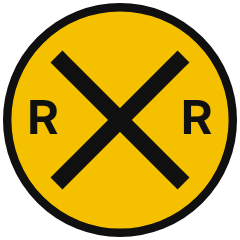
35. Where is this sign installed in relation to the hazard it announces?
Show answer
Answer A: Far enough before the hazard that a driver can slow down and stop short of it
This is an advance warning sign, placed on the approach so a driver has time to react before reaching a crossing that a curve or a crest may be hiding.
-
36. When must a New Hampshire driver dim the headlights during the hours of darkness?
Show answer
Answer D: When approaching, overtaking or following within about 150 feet of another vehicle
RSA 265:114 requires headlights to be dimmed when approaching, overtaking or following within approximately 150 feet of another vehicle during the period from half an hour after sunset to half an hour before sunrise.
-
37. Does using a hands free device remove the risk of distraction?
Show answer
Answer A: No, the conversation still takes attention away from driving
Hands free equipment removes the manual part of the distraction but not the mental part, and a driver deep in conversation can look straight at a hazard without registering it.
-
38. How long does New Hampshire suspend the driving privilege of a person with no prior impaired driving record who refuses the officer's designated test after arrest?
Show answer
Answer A: 180 days
RSA 265-A:14 imposes a 180-day suspension for a first refusal with no prior impaired driving conviction or refusal, and 2 years where there is such a prior.
-
39. May you park at the curb immediately next to a railroad crossing?
Show answer
Answer A: No, you must leave the crossing and its approach clear
Parking beside a crossing hides the tracks and the signals from approaching drivers and leaves no room for a vehicle that has to clear the rails.
-
40. A ball rolls into the street from between parked cars ahead of you. What should you expect and do?
Show answer
Answer A: Expect a child to follow it and be ready to stop
A ball is usually followed by a child who is watching the ball and not the traffic. Slow down and be prepared to stop immediately.