
New Hampshire NH DMV Permit Practice Test 1
Test 1 of 10. Pick an answer for each question to see if it is right and why; your score appears at the end. You need 32 correct answers to pass, the same ratio as the real New Hampshire test.
- Questions40
- Correct to pass32
- Passing score80%
- Minimum age16 years
-
1. You need to reverse direction on a busy street. Which choice is usually safest?
Show answer
Answer D: Driving around the block and using the intersections instead
Going around the block uses normal turns at controlled intersections instead of stopping across live traffic lanes.
-
2. How many New Hampshire demerit points follow a speeding conviction for less than 25 mph above the posted limit?
Show answer
Answer A: 3 points
New Hampshire assigns 3 demerit points for speeding under 25 miles per hour over the limit, and 4 points once the margin reaches 25 miles per hour.
-
3. What is the maximum speed limit on the portion of Interstate 93 from mile marker 45 to the Vermont border?
Show answer
Answer A: 70 mph
New Hampshire posts 70 mph only on I-93 between mile marker 45 and the Vermont border; the rest of the interstate system and the turnpikes are limited to 65 mph where they are divided highways of four or more lanes.
-
4. What should you avoid when a hostile driver pulls alongside you?
Show answer
Answer A: Making eye contact, or answering the gestures in any way at all
Any response, including a look, encourages an aggressive driver, so give none and let the vehicle go.
-
5. How can you check that you are keeping a safe following distance?
Show answer
Answer A: Count at least three seconds between the vehicle ahead passing a fixed object and your reaching it
Pick a fixed roadside object, start counting when the vehicle ahead passes it and make sure at least three seconds elapse before you reach it, adding more time in poor conditions.
-
6. You are about to drive a rental car that you have never driven before. What should you do?
Show answer
Answer A: Adjust the seat and the mirrors and find the controls before moving off
Hunting for the wipers or the lights in traffic is a distraction, so learn the layout while the vehicle is stopped.
-
7. Where is the best place in the car for a child safety seat?
Show answer
Answer A: In the rear seat, secured either with the belt or with the lower anchors
The rear seat is furthest from most impacts and from the front airbags, and the seat must be locked in with the belt or the anchors.
-
8. Traffic is backed up just past the exit you want to use at a single-lane roundabout. What should you do?
Show answer
Answer D: Wait at the yield line until you can pass through and exit
You must not enter a roundabout unless you can clear it, because stopping inside blocks every other entry.
-
9. What does New Hampshire's Sherrill's Law require of a driver approaching a crash scene, a traffic stop or a stopped vehicle showing warning signals?
Show answer
Answer D: Maintain a reduced speed, give a wide berth where practical, obey any person directing traffic, and vacate a blocked lane as soon as possible
RSA 265:37-a requires drivers to keep a reduced speed, give a wide berth where practical without endangering oncoming traffic, obey anyone directing traffic, and vacate any blocked lane as soon as possible.
-
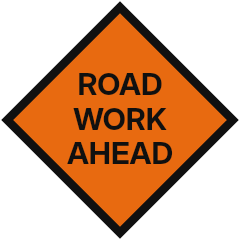
10. This sign is still standing late at night, and nobody is working. What should the driver assume?
Show answer
Answer B: The layout may still be altered, so the same care and reduced speed apply
Narrowed lanes, shifted alignments, dropped pavement edges and parked equipment remain overnight, so the hazard does not end when the crew goes home.
-
11. For how long do demerit points assessed for a New Hampshire conviction appear on a certified copy of a driver record?
Show answer
Answer A: Three years from the date of the violation
The NH DMV states that the demerit points assessed for a motor vehicle conviction appear on a certified copy of a record for three years from the date of the violation.
-
12. While you wait for the ambulance at a crash, what is the most useful help you can give?
Show answer
Answer C: Keep the person still and warm, and press down firmly on any heavy bleeding
Keeping an injured person still and warm and controlling bleeding are among the few things a bystander can safely do.
-
13. What is lane splitting?
Show answer
Answer B: A motorcycle riding between two lanes of traffic moving the same way
Lane splitting means riding along the line between two lanes of traffic going in the same direction rather than staying within a lane.
-
14. What must a New Hampshire applicant read to pass the DMV vision test?
Show answer
Answer A: The 20/40 line with both eyes
The NH DMV requires an applicant to read the 20/40 vision line with both eyes, and anyone who needs glasses or contact lenses to do so must wear them whenever driving.
-
15. A school crossing guard has returned to the curb but two children are still walking across the road. When may you go?
Show answer
Answer C: Only after the children have reached the far sidewalk
The guard leaving the road does not end your duty; you stay stopped until every child is clear of the roadway.
-
16. Under New Hampshire's hands-free law, what may a driver over 18 legally do?
Show answer
Answer A: Use a Bluetooth or other hands-free device, and use one hand on a non-cellular two-way radio
RSA 265:79-c bans handheld device use while driving or temporarily halted in traffic, but drivers over 18 may use a hands-free device and may use one hand on a non-cellular two-way radio.
-
17. You are passing a large truck on an open highway in a strong crosswind. What should you expect?
Show answer
Answer A: A push toward the truck, then a push the other way as you clear it
The truck shelters you as you go by and then releases you into the full gust, so the load on the steering changes twice during the pass.
-
18. What is threshold braking?
Show answer
Answer C: Braking hard but staying just short of locking the wheels
A rolling tire grips better than a sliding one, so the shortest stop comes from pressure held just below the point where the wheels lock.
-
19. What mandatory sentence applies when a New Hampshire driver drives while under a revocation imposed for driving while intoxicated?
Show answer
Answer A: Imprisonment for not less than seven consecutive 24-hour periods and an extra year of revocation
RSA 263:64 makes this a misdemeanor with a mandatory minimum of seven consecutive 24-hour periods of imprisonment, a fine of up to $1,000 and an additional year of revocation, none of which may be suspended.
-
20. The signal ahead has a sign prohibiting left turns, and your route needs a left. What should you do?
Show answer
Answer D: Go straight on and find a legal place to turn and come back
A turn prohibition applies to every driver, so you continue through and reach your route by another legal turn.
-
21. A driver on a hands free call looks straight at a red light and drives through it. What best explains this?
Show answer
Answer B: The eyes saw it but the brain did not process it
Attention, not eyesight, decides what a driver actually sees, and a loaded mind can leave a driver looking straight at a hazard without registering it.
-
22. You cannot avoid a wide puddle that covers only the right half of your lane. What should you expect?
Show answer
Answer D: The water can tug the vehicle toward that side, so slow before it and grip the wheel
Water dragging on the tires of one side only pulls the vehicle that way. Reduce speed before you reach it and hold the wheel firmly.
-
23. A curb lane is marked BUS ONLY 7 AM TO 9 AM. What may the driver of a car do?
Show answer
Answer A: Use the lane outside those hours
A part-time bus lane is reserved only during the posted period, and outside it the lane serves general traffic like any other.
-
24. The light ahead is green but traffic beyond the intersection is backed up. What should you do?
Show answer
Answer B: Wait behind the intersection until there is room to clear it completely
You may not enter an intersection unless you can get completely through it, because stopping inside blocks cross traffic when the signal changes.
-
25. How far back must a New Hampshire driver stop for a school bus displaying flashing red lights or an extended stop arm?
Show answer
Answer C: At least 25 feet, in any direction, unless the roadway is separated by a physical barrier
New Hampshire requires drivers to stop at least 25 feet away in any direction from a bus with flashing red lights or an extended stop arm, unless a physical barrier separates the roadway.
-
26. A car is coming straight at you in your lane and there is no time for it to move back. What should you do?
Show answer
Answer A: Brake, sound the horn and steer to the right, toward the shoulder or ditch
Steering right takes you away from the other vehicle even if its driver corrects course, and the shoulder or ditch is survivable.
-
27. What does a yield sign require of a driver?
Show answer
Answer A: Slow down, and stop when necessary, so conflicting traffic can go first
A yield sign obliges the driver to reduce to a speed suited to conditions and to stop when needed so that conflicting traffic or pedestrians are not interfered with.
-
28. A yellow diamond shows a car with wavy lines behind its rear tires. What is the warning?
Show answer
Answer D: The surface loses grip badly when it is wet
The slippery when wet sign marks a stretch where traction falls off sharply in rain, so speed and braking must be reduced well in advance.
-
29. At 45 mph you look at a navigation screen for four seconds. Roughly how far do you travel unseeing?
Show answer
Answer D: About 260 feet
At 45 mph you cover roughly 66 feet a second, so four seconds on a screen is around 260 feet of road that you never looked at.
-
30. You are clear of the tracks after your vehicle stalled on a crossing. Whom should you contact?
Show answer
Answer C: The emergency number posted on the blue sign at the crossing, or 911
Grade crossings carry an emergency notification sign with a railroad phone number and a crossing identification number so that approaching trains can be stopped, and 911 works if that sign is not visible.
-
31. A rear tire blows out on the highway. How does the vehicle usually behave?
Show answer
Answer C: The back end weaves or fishtails from side to side
A rear failure shows up as the tail wandering rather than a pull on the steering, so hold the wheel straight and let the speed drop gradually.
-
32. A large panel mounted on a trailer at the roadside displays a flashing arrow pointing left. What does it tell you?
Show answer
Answer B: Move into the lane to your left
An arrow panel directs traffic out of a closed lane, so the arrow shows the direction you must move rather than the shape of the road ahead.
-
33. At an intersection where turning right on red is permitted and no sign prohibits it, what must you do before turning?
Show answer
Answer A: Come to a complete stop and yield to pedestrians and cross traffic
A right turn on red is allowed only after a full stop, and the turning driver must yield to pedestrians in the crosswalk and to traffic already using the intersection.
-
34. You are inside a tunnel with no shoulder when an ambulance comes up behind you with lights and siren. What should you do?
Show answer
Answer D: Keep going at a safe speed and pull over once you are clear of the tunnel
Stopping in a tunnel or on a narrow bridge blocks the only lane, so continue at a safe speed to the first place where you can pull clear.
-
35. Unless a different limit is posted, what is the New Hampshire maximum speed in a business or urban residence district?
Show answer
Answer B: 30 mph
New Hampshire sets 30 mph in any business or urban residence district and 35 mph in a rural residence district or on a Class V highway outside the compact part of a city or town.
-
36. Two New Hampshire vehicles collide on the traveled portion of a road and both can still be driven. What does the law require?
Show answer
Answer A: They must be moved off the traveled portion if that brings no further damage or injury
RSA 264:25-a overrides the ordinary conduct-after-accident duties so far as to require a driver to move the vehicle off the traveled portion of the roadway when that can be done without risk of further damage to property or injury to persons.
-
37. How can you keep space at the sides of your vehicle in heavy traffic?
Show answer
Answer D: Drive in the gaps between the other vehicles rather than beside them
Travelling in the open spaces rather than alongside others keeps a way out open on at least one side.
-
38. A New Hampshire driver aged 20 accumulates demerit points. Which accumulation exposes that driver to a suspension of up to one year?
Show answer
Answer D: 21 points in three calendar years
For a driver under 21 New Hampshire uses 9 points in one year, 15 points in two years and 21 points in three years, the last of which allows a suspension of up to one year.
-
39. Your vehicle is stuck in deep snow and you run the engine for heat while waiting for help. What must you check?
Show answer
Answer C: That the exhaust pipe is clear of snow
Snow packed around the tailpipe pushes exhaust back into the cabin, and carbon monoxide can kill without warning. Clear the pipe and crack a window open.
-
40. You hear a bang and one of the front tires deflates while you are on the highway. What happens to the vehicle?
Show answer
Answer D: It pulls strongly toward the side that failed
The collapsed tire drags heavily on that corner, so the vehicle veers toward it. Hold the wheel firmly, keep your line and let the speed fall before leaving the road.