
New Hampshire NH DMV Permit Practice Test 2
Test 2 of 10. Pick an answer for each question to see if it is right and why; your score appears at the end. You need 32 correct answers to pass, the same ratio as the real New Hampshire test.
- Questions40
- Correct to pass32
- Passing score80%
- Minimum age16 years
-
1. Which action involving equipment is expressly permitted while driving under the New Hampshire hand-held ban?
Show answer
Answer C: Performing any action required by an ignition interlock device
RSA 265:79-c lists performing an action required by an ignition interlock device among the exceptions to the hand-held prohibition, alongside emergency reporting and non-cellular two-way radio use.
-
2. You have stopped on the shoulder of a highway and want to rejoin the traffic. What is the correct way?
Show answer
Answer D: Signal, build up speed along the shoulder, then merge into a gap
Entering a fast lane at a slow speed is what causes the conflict, so the shoulder is used to gain speed before the merge in the same way as an acceleration lane.
-
3. What does a first conviction of reckless driving cost a New Hampshire driver?
Show answer
Answer B: A fine of at least $500 plus penalty assessment and a 60-day revocation
RSA 265:79 sets a minimum fine of $500 plus penalty assessment for a first reckless driving offense and revokes the license or operating privilege for 60 days.
-
4. On a busy multilane highway, where is the best place to travel?
Show answer
Answer B: In a gap in the traffic, with space open on both sides
Travelling in a gap keeps escape routes open on both sides, while riding alongside other vehicles removes the room you would need to swerve.
-
5. What prima facie speed limit does New Hampshire set for an unimproved rural highway?
Show answer
Answer C: 45 mph
RSA 265:60 sets a prima facie limit of 45 miles per hour on an unimproved rural highway as defined in RSA 259:116-a.
-
6. What does New Hampshire's Jessica's Law require before a vehicle is driven?
Show answer
Answer B: All snow and ice must be removed from the vehicle
Jessica's Law makes New Hampshire drivers legally responsible for clearing all snow and ice from a vehicle before driving, because loose ice can strike other vehicles.
-
7. What is the safest way to handle an unrestrained pet or a child who needs attention while you are driving?
Show answer
Answer D: Secure pets before the trip and pull over safely before attending to a child
A loose animal or an urgent situation in the back seat can capture a driver's attention completely, so restrain pets beforehand and stop in a safe place when someone needs help.
-
8. Reaching for a drink in the cup holder is which kind of distraction?
Show answer
Answer A: Manual and visual at the same time
Your hand leaves the wheel and your eyes flick down to find the cup, so a task that feels trivial takes away two of the three things driving needs.
-
9. You have begun to move into the next lane when the gap you were aiming for closes. What is the safest action?
Show answer
Answer C: Return to your own lane, cancel the signal and wait for a better gap
An unfinished lane change leaves you in a space that no longer exists, and the lane you came from is still yours.
-
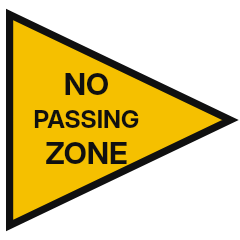
10. Where does the restriction that starts at this sign come to an end?
Show answer
Answer D: Where the centerline markings show that overtaking is allowed again
The sign marks the start of the restricted section, and the centerline markings along the road show how far it runs and where overtaking becomes lawful again.
-
11. Is it acceptable to drive far below the flow of traffic on an open highway?
Show answer
Answer B: No, driving too slowly can obstruct traffic and create a hazard
Traffic that is much slower than the surrounding flow forces other drivers into sudden braking and unnecessary passing maneuvers, and impeding traffic is itself a violation.
-
12. You wait in the aisle with your signal on for a space that is about to be vacated. What is the risk?
Show answer
Answer D: You block the aisle and drivers behind may try to squeeze past
A stopped vehicle turns a two-way aisle into a bottleneck, and drivers who try to get around it pass close to pedestrians and reversing cars.
-
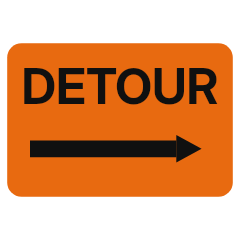
13. Which of these is true of the roadway a driver is being sent onto here?
Show answer
Answer D: Its own signs, signals and speed limits govern for the whole way around
The alternate route is an ordinary public road, so every control posted on it governs as usual; being sent that way grants no extra priority and no relief from the limits in force there.
-
14. On a street with parking along the curb, the shared lane marking is painted well out from the curb face. What does that placement tell a bicyclist?
Show answer
Answer C: To ride clear of the doors of parked cars
The marking is set at least eleven feet from the curb where parking is allowed so that riders are guided outside the reach of an opening door.
-
15. Some crosswalks are marked with two transverse lines and others with a row of wide bars laid along the direction of travel. Why is the second pattern used?
Show answer
Answer B: It is far easier for an approaching driver to see
Longitudinal bar patterns are used where extra visibility is wanted, such as an uncontrolled crossing or one near a school, because they show up much better from a car.
-
16. Your right wheels drop off the edge of the pavement onto a soft shoulder. What should you do?
Show answer
Answer C: Ease off the accelerator, hold the wheel straight and steer back gently once you have slowed
Yanking the wheel while the tires are pressed against a pavement lip can throw the vehicle across the road, so slow down first and then make a gentle correction.
-
17. What must a New Hampshire school bus driver do when road conditions and space permit and five or more vehicles are following?
Show answer
Answer B: Pull over and let the following vehicles pass
RSA 265:54 requires a school bus driver to pull over and let following vehicles pass whenever conditions and space permit and five or more vehicles are behind, and a passing driver must not cross an unbroken painted line.
-
18. You are entering a marked work zone. What should you expect?
Show answer
Answer B: A reduced posted speed, narrowed or shifted lanes, and traffic that may stop suddenly
Work zones change the geometry of the road and can bring traffic to a halt without warning, so the posted work zone speed and increased following distance both apply.
-
19. You want to turn left across the oncoming lane into a shopping center driveway. Who must you yield to?
Show answer
Answer B: Oncoming traffic and anyone using the sidewalk
A left turn into a driveway crosses both the oncoming lane and the sidewalk, so you give way to traffic and to pedestrians before completing it.
-
20. What does a NARROW BRIDGE warning sign tell a driver?
Show answer
Answer A: The bridge is tighter than the road leading up to it
A narrow bridge still carries both directions, but with much less clearance than the approaches, so drivers should slow and hold their lane position carefully.
-
21. What does New Hampshire law allow in the way of aftermarket window tinting?
Show answer
Answer C: No windshield tint except a top strip, and at least 70 percent transmittance beside the driver
RSA 266:58-a bars aftermarket tinting on the windshield apart from a strip no wider than 6 inches at the top, requires at least 70 percent light transmittance on windows beside the driver and at least 35 percent on rear windows where tint is allowed.
-
22. A school sign combined with an AHEAD plaque, or with a plaque giving a distance in feet, forms an assembly that
Show answer
Answer B: warns of a school crossing located further along the road
The school advance crossing assembly is placed before the crosswalk to give drivers notice, while a different assembly marks the crossing itself.
-
23. Why should you not leave the engine running when you walk away from your vehicle?
Show answer
Answer C: Because the vehicle can be stolen or can move on its own
An unattended running vehicle is an easy theft and, if the transmission slips or is knocked out of park, it can roll away with nobody at the wheel.
-
24. What penalty does New Hampshire attach to overtaking a stopped school bus on the right when a stop was required?
Show answer
Answer D: A $500 fine plus penalty assessment and a suspension of up to 30 days
RSA 265:54 makes overtaking a school bus on the right a separate offense with a $500 fine plus penalty assessment and a license suspension of up to 30 days for a first offense.
-
25. A child in the back seat unfastens a seat belt while you are on the freeway. What should you do?
Show answer
Answer A: Pull off safely and refasten the belt
Turning or reaching back takes your eyes and hands off a high speed task, so leave the freeway or use the shoulder only if there is no exit, then fix the belt.
-
26. It is dark, it is raining and you are towing a trailer. How should you set your following gap?
Show answer
Answer B: Add extra seconds for each condition, well beyond three
Each factor that lengthens your stopping distance or shortens your view calls for another second or more, and they add up when several occur together.
-
27. Where is a U-turn most clearly unsafe and generally prohibited?
Show answer
Answer D: On a curve or near a hill crest, where other drivers cannot see you
U-turns are barred where approaching drivers cannot see you in time, such as on a curve or near the top of a hill.
-
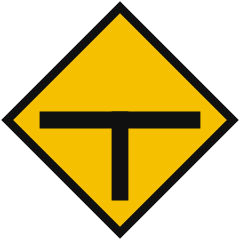
28. What must a driver be prepared to do at the point this sign refers to?
Show answer
Answer D: Turn left or right, because the road being traveled ends there
The road ends at another roadway, so the driver must slow, give way to traffic on the through road and turn in one direction or the other.
-
29. What does a flashing yellow traffic light mean?
Show answer
Answer B: Slow down and proceed with caution
A flashing yellow lets you enter the intersection cautiously after yielding to pedestrians and to conflicting traffic that is already there.
-
30. You are driving at night on an unlit road using low beams. How should you choose your speed?
Show answer
Answer C: So you could stop within the distance your headlights light up
Driving faster than you can stop within the lit area is called overdriving your headlights. Anything beyond the beam is invisible until it is too late to react.
-
31. On a two-lane road, a solid yellow line runs on your side of the center while a broken yellow line runs on the other side. What does this mean?
Show answer
Answer D: You may not pass, although oncoming drivers may
Passing restrictions are read from the line closest to your own lane, so a solid yellow line on your side creates a no-passing zone for you alone.
-
32. The car ahead drifts across the lane line and back again several times. What should you do?
Show answer
Answer C: Assume that the driver is distracted or impaired, and keep well back
Drifting is a classic sign of a distracted, drowsy or impaired driver, and distance is your protection from all three.
-
33. When may New Hampshire license a 16-year-old who has not completed an approved driver education course?
Show answer
Answer A: When no transport to school is readily available, on a license limited to school travel
RSA 263:21 lets the director issue a license limited to travel to and from school and school assignments when no readily available transport exists and driver education would cause undue hardship.
-
34. A friend who has been drinking insists on driving home. What is the right thing to do?
Show answer
Answer B: Take the keys and arrange a sober ride, even if the friend objects
An impaired driver is dangerous on any street at any speed, and coffee does not lower blood alcohol. Keeping the keys and finding another way home is the only safe choice.
-
35. You are behind three slow vehicles on a two-lane road and the way ahead looks clear. What is the sound decision?
Show answer
Answer D: Pass one vehicle at a time, if the road allows it
Passing several vehicles in one move keeps you in the oncoming lane far too long and leaves nowhere to go if a vehicle appears.
-
36. A 19-year-old New Hampshire driver carries alcohol in the car with no parent, guardian or other listed relative aboard. What may follow?
Show answer
Answer B: A suspension of 60 days
RSA 265-A:45 forbids a driver under 21 to transport liquor, beverage or marijuana unless accompanied by a listed relative or legal age spouse, and allows a 60-day suspension for a violation.
-
37. How far before a New Hampshire school crossing guard who is signaling to stop must a driver bring the vehicle to a halt?
Show answer
Answer B: At least 25 feet
RSA 265:3-a requires a driver to stop at least 25 feet before a school crossing guard who is displaying a stop signal, and to wait until the guard indicates that traffic may proceed.
-
38. When does New Hampshire law require headlights to be switched on?
Show answer
Answer B: From half an hour after sunset to half an hour before sunrise, and whenever rain, snow or fog blocks a clear view of the road at 1,000 feet
New Hampshire requires at least two lighted lamps on the front from half an hour after sunset to half an hour before sunrise, and whenever rain, snow or fog prevents seeing persons and vehicles clearly at 1,000 feet ahead; one lamp is sufficient on a motorcycle.
-
39. A motorcycle ahead of you is weaving slightly as it crosses a stretch of grooved pavement. What should you do?
Show answer
Answer D: Give the rider extra room until the surface improves
Grooves, metal plates and loose material affect a motorcycle far more than a car, so back off and let the rider deal with the surface.
-
40. On a rural two-lane road you pass small blue signs, each naming one business with an arrow and a distance. What are they?
Show answer
Answer D: Tourist-oriented directional signs for traveler businesses
Tourist-oriented directional signs carry a white legend on blue and are used on rural conventional roads to guide travelers to eligible businesses.