
New Hampshire NH DMV Motorcycle Practice Test 3
Test 3 of 6. Pick an answer for each question to see if it is right and why; your score appears at the end. You need 20 correct answers to pass, the same ratio as the real New Hampshire test.
- Questions25
- Correct to pass20
- Passing score80%
- Minimum age16 years
-
1. You are waiting to turn left at a solid green light with no green arrow. Oncoming traffic is approaching. What should you do?
Show answer
Answer A: Yield to the oncoming traffic and turn only when there is a safe gap
A solid green light permits the left turn but does not protect it, so you must yield to oncoming vehicles and to pedestrians before turning.
-
2. What restrictions apply while riding on a New Hampshire motorcycle learner permit?
Show answer
Answer A: Riding only after sunrise and before sunset, and carrying no passengers
A New Hampshire motorcycle learner permit allows riding on any state road after sunrise and before sunset, and the holder may not carry any passengers.
-
3. What does New Hampshire's Sherrill's Law require of a driver approaching a crash scene, a traffic stop or a stopped vehicle showing warning signals?
Show answer
Answer D: Maintain a reduced speed, give a wide berth where practical, obey any person directing traffic, and vacate a blocked lane as soon as possible
RSA 265:37-a requires drivers to keep a reduced speed, give a wide berth where practical without endangering oncoming traffic, obey anyone directing traffic, and vacate any blocked lane as soon as possible.
-
4. What mandatory sentence applies when a New Hampshire driver drives while under a revocation imposed for driving while intoxicated?
Show answer
Answer A: Imprisonment for not less than seven consecutive 24-hour periods and an extra year of revocation
RSA 263:64 makes this a misdemeanor with a mandatory minimum of seven consecutive 24-hour periods of imprisonment, a fine of up to $1,000 and an additional year of revocation, none of which may be suspended.
-
5. What does a light drag of the rear brake do during a slow, tight turn?
Show answer
Answer C: It steadies the motorcycle and smooths out the power reaching the rear wheel
Working the rear brake against a slipping clutch takes the jerkiness out of the drivetrain and holds the machine steady through the turn.
-
6. What does New Hampshire law say about two motorcycles sharing a lane and about riding between lanes?
Show answer
Answer C: Two may ride abreast in one lane, but riding between lanes is prohibited
RSA 265:121 entitles a motorcycle to the full use of a lane, allows two motorcycles and no more to ride abreast in a single lane, and forbids riding between lanes or between adjacent lines of vehicles.
-
7. You are following closely behind a vehicle you intend to pass on a two-lane road. What should you do first?
Show answer
Answer D: Drop back to give yourself room to build speed before you pull out
From close behind you cannot see far enough ahead and you have no room to gather speed, so the pass takes longer and starts blind.
-
8. How many demerit points does New Hampshire assess for operating a motorcycle without a motorcycle license, under RSA 263:30?
Show answer
Answer C: 2 points
New Hampshire assigns 2 demerit points for operating without a motorcycle license, the same value it gives to driving with an improper class of license.
-
9. You cannot avoid an obstacle lying in the road. At what angle should you try to cross it?
Show answer
Answer D: As close to 90 degrees as possible
Meeting the obstacle squarely keeps the front wheel from being deflected sideways as it climbs over the edge.
-
10. Two New Hampshire vehicles collide on the traveled portion of a road and both can still be driven. What does the law require?
Show answer
Answer A: They must be moved off the traveled portion if that brings no further damage or injury
RSA 264:25-a overrides the ordinary conduct-after-accident duties so far as to require a driver to move the vehicle off the traveled portion of the roadway when that can be done without risk of further damage to property or injury to persons.
-
11. Within what time must a New Hampshire license holder tell the director of a change of legal name, permanent residence or mailing address?
Show answer
Answer C: Within 30 days, in writing
RSA 263:9 requires written notice to the director within 30 days of a change of legal name, permanent residence or mailing address.
-
12. What speed does New Hampshire law allow for a transponder-equipped vehicle passing through a toll booth or gate fitted with a transponder reader, other than an open road tolling lane?
Show answer
Answer D: 25 mph
RSA 265:60 sets 25 miles per hour for a transponder-equipped vehicle through an automated toll booth or gate, apart from open road tolling lanes.
-
13. What is the danger of riding in cold weather with thin gloves?
Show answer
Answer C: Cold, numb hands respond slowly and lose their feel for the controls
Wind chill at riding speed cools the hands quickly, and numb fingers are slower and less precise on the clutch, throttle and brake.
-
14. How many New Hampshire demerit points follow a speeding conviction for less than 25 mph above the posted limit?
Show answer
Answer A: 3 points
New Hampshire assigns 3 demerit points for speeding under 25 miles per hour over the limit, and 4 points once the margin reaches 25 miles per hour.
-
15. You are entering a marked work zone. What should you expect?
Show answer
Answer B: A reduced posted speed, narrowed or shifted lanes, and traffic that may stop suddenly
Work zones change the geometry of the road and can bring traffic to a halt without warning, so the posted work zone speed and increased following distance both apply.
-
16. At night you are waiting to turn left and can see only the headlights of an approaching vehicle. Why should you allow a bigger margin?
Show answer
Answer D: Because lights alone make speed and distance hard to judge
With no other visual cues, two points of light give you very little information about how fast the vehicle is closing, so leave extra margin.
-
17. How does alcohol change the time a driver needs to respond to a hazard?
Show answer
Answer A: It slows it, so stopping takes longer
Alcohol is a depressant that lengthens the time between seeing a hazard and acting on it, which adds directly to the distance needed to stop.
-
18. A freeway sign shows a minimum speed limit. What does it require?
Show answer
Answer B: That you keep up with it unless conditions make that unsafe
A minimum speed limit keeps very slow vehicles off the highway, but weather, traffic or a mechanical problem may make a lower speed necessary and lawful.
-
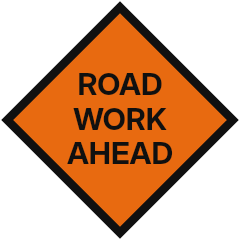
19. Beyond this sign, cones and temporary signs lead traffic along a path that does not agree with the lines painted on the pavement. Which one must the driver follow?
Show answer
Answer C: The temporary arrangement, because it replaces the permanent layout while the work lasts
Temporary traffic control set up for the work takes precedence over the permanent signs and markings, which no longer describe how the road is being used.
-
20. How do worn tires and worn brakes affect your ability to stop?
Show answer
Answer C: They lengthen the stopping distance, especially on a wet road
Worn tread cannot clear water and worn brakes cannot produce full force, so both stretch the distance needed to stop.
-
21. You signaled a lane change and the signal did not switch itself off afterwards. Why does that matter?
Show answer
Answer B: Other drivers may act on a turn you do not intend to make
A signal left on tells other drivers you are about to turn, and someone may pull out in front of you. Cancel it as soon as the maneuver is finished.
-
22. You stop at a rest area because you are sleepy. How long a nap is usually recommended?
Show answer
Answer D: About fifteen to twenty minutes
A short nap of fifteen to twenty minutes restores useful alertness without leaving the grogginess a longer sleep can bring, and you should wait a few minutes before driving on.
-
23. Unless a different limit is posted, what is the New Hampshire maximum speed in a business or urban residence district?
Show answer
Answer B: 30 mph
New Hampshire sets 30 mph in any business or urban residence district and 35 mph in a rural residence district or on a Class V highway outside the compact part of a city or town.
-
24. What is sensible when you drive in an unfamiliar town for the first time?
Show answer
Answer C: Drive a little slower and give yourself more time to read the signs
In unfamiliar surroundings you need longer to take in signs, junctions and markings, and lower speed buys that time.
-
25. You are leaving a freeway at an exit that has a deceleration lane. Where should you slow down?
Show answer
Answer C: After you have moved fully into the exit lane
Braking in a through lane surprises the traffic behind you, so you move into the exit lane at highway speed and then slow down inside it.