
New Hampshire NH DMV Motorcycle Practice Test 1
Test 1 of 6. Pick an answer for each question to see if it is right and why; your score appears at the end. You need 20 correct answers to pass, the same ratio as the real New Hampshire test.
- Questions25
- Correct to pass20
- Passing score80%
- Minimum age16 years
-
1. A center lane is bordered by a solid yellow line on the outside and a broken yellow line on the inside, with left-turn arrows painted in it. How may you use that lane?
Show answer
Answer A: Only to make a left turn or to prepare for one from either direction
That marking identifies a two-way left turn lane, which may only be used for left turns or to prepare for a left turn and never for travel or passing.
-
2. Why are sign shapes and colors standardized across the whole country?
Show answer
Answer D: So a driver knows the kind of message before reading it
Uniform shapes and colors let a driver classify a sign as regulatory, warning or guide from a distance, before the legend can be read.
-
3. What does it mean to scan the road while driving?
Show answer
Answer A: Moving your eyes constantly over the road, the sides and the mirrors
Scanning keeps information coming in from every direction, while a fixed stare leaves you blind to everything else.
-
4. When New Hampshire local authorities alter a prima facie speed limit after an engineering or traffic investigation, what bounds does the statute impose?
Show answer
Answer C: They may raise a limit inside an urban district to no more than 60 mph and may not lower a limit below 25 mph
RSA 265:63 lets local authorities increase a limit within an urban district up to 60 miles per hour and decrease limits, but never below 25 miles per hour.
-
5. You are approaching a sharp curve. When should you reduce your speed?
Show answer
Answer D: Before you enter the curve, so you can accelerate gently through it
Braking hard inside a curve uses up the traction that is already being demanded for cornering, so the slowing must be finished before you enter.
-
6. When must a New Hampshire driver dim the headlights during the hours of darkness?
Show answer
Answer D: When approaching, overtaking or following within about 150 feet of another vehicle
RSA 265:114 requires headlights to be dimmed when approaching, overtaking or following within approximately 150 feet of another vehicle during the period from half an hour after sunset to half an hour before sunrise.
-
7. You are turning left from a one-way street onto another one-way street. Which lane should you use?
Show answer
Answer B: Turn from the far left lane into the far left lane of the new street
The general turning rule is to turn from the lane nearest the direction of the turn into the nearest lane of the new roadway, which on a one-way to one-way left turn means far left to far left.
-
8. Why can a mild afternoon still chill a rider dangerously on the highway?
Show answer
Answer B: Riding speed creates a wind chill well below the air temperature
Air moving over the body at highway speed strips heat far faster than still air, so a comfortable temperature at a standstill can cause serious chilling in an hour of riding.
-
9. What fine does New Hampshire set for failing in the duties owed when approaching a highway emergency?
Show answer
Answer A: $75 plus penalty assessment, rising to $250 for a repeat within 12 months
RSA 265:37-a fines a violator $75 plus penalty assessment for a first offense and $250 plus penalty assessment for a subsequent offense within a 12-month period.
-
10. How long does New Hampshire suspend the driving privilege of a person with no prior impaired driving record who refuses the officer's designated test after arrest?
Show answer
Answer A: 180 days
RSA 265-A:14 imposes a 180-day suspension for a first refusal with no prior impaired driving conviction or refusal, and 2 years where there is such a prior.
-
11. What benefit does completing the New Hampshire Basic Rider Class bring?
Show answer
Answer C: The rider can obtain a motorcycle license without further testing at the NH DMV, using a completion card issued within the past year
Successful completion of the New Hampshire Basic Rider Class lets a rider obtain the motorcycle license without further DMV testing, provided the completion card shows a pass within the past year.
-
12. On a New Hampshire road that is not a school zone, not a business or residence district, not an unimproved rural highway and not a divided highway of four or more lanes, and where no limit is posted, what speed is prima facie lawful?
Show answer
Answer B: 55 mph
RSA 265:60 makes 55 miles per hour the prima facie limit in locations the statute does not otherwise describe.
-
13. Where is the no passing zone pennant sign installed?
Show answer
Answer A: On the left side of the roadway
The pennant is placed on the left side of the roadway at the beginning of the no-passing zone, in the field of view of a driver who is thinking about overtaking.
-
14. A New Hampshire vehicle breaks down in a travel lane but can still be driven. What does the law require?
Show answer
Answer C: The driver must move it at once to the shoulder or another safe area
RSA 265:37-b requires a driver whose vehicle is stopped in the roadway to move it immediately to the shoulder or another safe area off the traveled portion when the vehicle is movable and the driver is able to move it.
-
15. You spot a deep pothole that the riders behind you will not be able to see until it is too late. What is the usual way to warn them?
Show answer
Answer B: Point at it with a hand or a foot on the side it lies on
Pointing at the hazard on the correct side tells the riders behind both that something is there and where in the lane it is.
-
16. When must a New Hampshire motorcycle rider wear eyeglasses, goggles or a protective face shield?
Show answer
Answer D: Whenever the machine has no windshield or screen protecting the eyes and face
RSA 265:123 requires a rider whose motorcycle has no windshield or screen protecting the eyes and face when sitting erect to wear eyeglasses, goggles or a protective face shield while the machine is in motion.
-
17. You are about to slow down sharply for a turn. Which check comes first?
Show answer
Answer A: A look in the mirror to see how close the traffic behind you is
Any hard slowing needs a mirror check first, because the driver behind is the one who has to react to it.
-
18. Cannabis is legal for adults in some states. What does that mean for driving?
Show answer
Answer C: Driving while impaired by it is still an offense
Legal possession has nothing to do with driving law, and every state treats driving while impaired by cannabis as an offense.
-
19. How should a long trip be broken up to keep the driver alert?
Show answer
Answer D: Stop for a break every couple of hours and share out the driving
Regular breaks and a change of driver are the only reliable answers to fatigue; caffeine only postpones it.
-
20. What does New Hampshire require of a person who wants to ride a moped but holds no driver or motorcycle license?
Show answer
Answer B: A restricted moped license, obtained by passing a written examination
RSA 263:33-a directs the department to issue a restricted moped license to applicants who pass a written examination, and no one may ride a moped on a way without a driver license, a motorcycle license or that restricted license.
-
21. Why do drivers so often misjudge how fast an approaching motorcycle is traveling?
Show answer
Answer C: A narrow vehicle seems to grow slowly, so it appears further away
A small frontal area changes size slowly as it approaches, so drivers read a motorcycle as further away and slower than it really is. Never assume a waiting driver has judged your speed correctly.
-
22. What does a New Hampshire three-wheeled motorcycle endorsement allow?
Show answer
Answer B: Driving any registered three-wheeled motorcycle without another class of license, but never a two-wheeled motorcycle
A New Hampshire three-wheeled motorcycle endorsement holder may drive any registered three-wheeled motorcycle without holding another class of driver license, but may not drive a two-wheeled motorcycle.
-
23. A driver extends the left arm out the window and points it downward toward the road surface. What is being signaled?
Show answer
Answer A: Slowing down or stopping
The left arm extended downward is the standard hand signal for slowing or stopping.
-
24. At the scene of a crash you were part of, what are you required to do besides stopping?
Show answer
Answer B: Give your name, your address and vehicle details, and help anyone who is hurt
Every state requires drivers involved in a crash to identify themselves and to render reasonable aid to anyone injured.
-
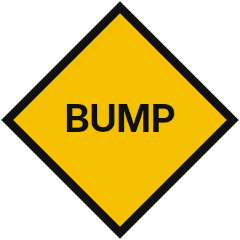
25. Why does this warning matter more on a motorcycle than in a car?
Show answer
Answer B: Because a sudden jolt can unsettle a two-wheeled machine and the rider can lose control
A jolt can push a motorcycle off line or lift a wheel, so a rider slows early, comes slightly off the seat and keeps a relaxed but firm hold on the handlebars.