
New Hampshire NH DMV Motorcycle Practice Test 49
- Questions25
- Correct to pass20
- Passing score80%
- Minimum age16 years
-
1. What does it mean to scan the road while driving?
Show answer
Answer A: Moving your eyes constantly over the road, the sides and the mirrors
Scanning keeps information coming in from every direction, while a fixed stare leaves you blind to everything else.
-
2. As a general rule, how far should you travel along a center two-way left-turn lane before you turn?
Show answer
Answer C: Only a short distance, just enough to slow down and wait for a gap
The center lane is for making or preparing a left turn, so you enter it only shortly before the turn and never travel along it as a through lane; several states set a specific limit such as 200 or 300 feet.
-
3. What should a rider understand about the horn on a motorcycle?
Show answer
Answer A: It is often weak and may not be heard, so it never replaces an escape route
A small horn competes with a closed car, a radio and traffic noise, so a rider plans a way out instead of trusting the horn to be heard.
-
4. You reach a stop-controlled intersection at the same time as a driver on your left, but that driver is already moving through the crossing. Who goes first?
Show answer
Answer C: The driver who is already inside the intersection
A vehicle already in the intersection has the right of way, and the rule about yielding to the right applies only before anyone has entered.
-
5. Is it a good idea to shift into neutral and coast down a long hill to save fuel?
Show answer
Answer B: No, you lose engine braking and some control of the vehicle
In neutral the engine cannot help slow the vehicle, so the brakes do all the work and can overheat. Stay in gear so the drivetrain helps hold your speed.
-
6. You pass into a work zone with a reduced speed limit but you see no workers. What speed applies?
Show answer
Answer D: The posted work zone limit, whether or not workers are present
A posted work zone speed limit is a regulatory limit in force at all times, and narrow lanes and uneven surfaces remain dangerous when nobody is working.
-
7. How much space should the leader of a group keep behind the vehicle ahead of the group?
Show answer
Answer D: At least the normal following distance a rider would keep when riding alone
Riding in a group does not shorten the space a motorcycle needs to stop, so the leader keeps the same cushion any rider would keep alone.
-
8. What is the job of the hard outer shell of a motorcycle helmet?
Show answer
Answer D: To spread impact force and to resist objects punching through
The shell distributes a concentrated blow over a wide area and stops sharp objects from reaching the head, while the liner underneath absorbs the energy.
-
9. What is the correct order of steps for taking a turn or a curve?
Show answer
Answer D: Slow, look, press, roll
Reduce speed before the turn, look through it to where you want to go, press the handgrip to lean, then roll on the throttle to steady the motorcycle.
-
10. Why may the mirrors and the headlight need readjusting when a passenger is carried?
Show answer
Answer D: Because the added weight changes the angle at which the motorcycle sits
Weight on the rear of the motorcycle raises the front, which aims the headlight and the mirrors higher than the rider intends.
-
11. You are moving at walking pace through a crowded parking area. Which combination gives the steadiest control?
Show answer
Answer B: Steady throttle, the clutch held in the friction zone and light rear brake
Slipping the clutch in the friction zone against a steady throttle and a light drag of rear brake keeps power smooth and the machine stable below walking speed.
-
12. What does a posted speed limit sign represent?
Show answer
Answer B: The maximum speed permitted under ideal conditions
A speed limit is an upper limit that assumes good weather, good visibility and light traffic, so the safe speed is often lower than the posted figure.
-
13. When is it safe to return to your own lane after passing a vehicle?
Show answer
Answer C: Once you can see the whole front of that vehicle in your mirror
Seeing the entire front of the vehicle in the mirror proves there is a full vehicle length of clear road, which the rider cannot judge by feel alone.
-
14. At a railroad crossing with no gates and no flashing lights, the crossbuck is normally combined with which sign?
Show answer
Answer C: A yield sign, or a stop sign where an engineering study calls for one
At a passive crossing the crossbuck forms an assembly with a yield sign, or with a stop sign when an engineering study or engineering judgment supports it, so the driver knows who must give way to the train.
-
15. A bicyclist ahead of you puts the left arm straight out to the side. What is being signaled?
Show answer
Answer B: A left turn or a move to the left
The left arm held straight out is the bicycle signal for a left turn, so hold back and give the rider room to cross toward the center.
-
16. You are turning left from a one-way street onto a two-way street. How should the turn be made?
Show answer
Answer B: Start in the far left lane and finish just to the right of the center line
Left turns begin from the lane nearest the left edge of the street you are leaving and must finish on the right-hand side of the center line of a two-way street.
-
17. You reach a one-lane bridge and a vehicle is already partway across it coming toward you. What should you do?
Show answer
Answer D: Stop before the bridge and let it come through
A vehicle already on a one-lane bridge has the right of way, and the driver who has not yet entered waits at the approach.
-
18. You are in the middle lane of a one-way street with three lanes when a police car approaches from behind with lights and siren. What should you do?
Show answer
Answer C: Pull to the nearest curb and stop clear of the lanes
On a one-way street you clear to whichever curb is closest, so the emergency vehicle gets a clear path down the open lanes.
-
19. A dog is running toward the road from a yard ahead of you. Why is it a mistake to simply accelerate past it?
Show answer
Answer A: A dog aims at where you will be, so more speed can bring you together
A dog runs at an intercept point rather than at where you are now, which is why the recommended technique is to slow as you approach and then accelerate away once you are beside it.
-
20. What should a passenger do when the motorcycle leans into a curve?
Show answer
Answer A: Lean with the operator, staying directly behind them
A passenger who leans with the operator lets the motorcycle follow its natural line, while leaning against the lean fights the operator's control inputs.
-
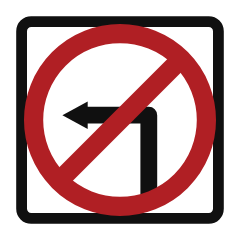
21. No plaque stating days or hours accompanies this sign at the intersection. When does the restriction apply?
Show answer
Answer D: At all times, since nothing limits it to particular periods
A regulatory restriction runs continuously unless a supplemental plaque states the days or hours during which it applies.
-
22. On a long drive you notice repeated yawning, missed exits and drifting toward the lane line. What should you do?
Show answer
Answer C: Pull off at a safe place and sleep, or change drivers
Those are warning signs that sleepiness is already interfering with driving, and only rest restores alertness. Fresh air, music and caffeine do not reverse it.
-
23. You are approaching the entry of a roundabout and a pedestrian is crossing the marked crosswalk on your approach lane. What must you do?
Show answer
Answer D: Stop before the crosswalk and let the pedestrian cross
Roundabout crosswalks sit a short distance back from the yield line, and drivers must yield there before they ever reach the circulating lanes.
-
24. What does a yield sign require of a driver?
Show answer
Answer A: Slow down, and stop when necessary, so conflicting traffic can go first
A yield sign obliges the driver to reduce to a speed suited to conditions and to stop when needed so that conflicting traffic or pedestrians are not interfered with.
-
25. On a long, straight highway you feel your attention fading. What helps you stay alert?
Show answer
Answer A: Keep your eyes moving, scan mirrors and signs, and take regular breaks
Staring at one point brings on highway hypnosis. Active scanning keeps the mind engaged, and a break every couple of hours restores alertness.