
New Hampshire NH DMV Motorcycle Practice Test 48
- Questions25
- Correct to pass20
- Passing score80%
- Minimum age16 years
-
1. About how far ahead do low beam headlights let you see on a dark road?
Show answer
Answer B: About 250 feet
Low beams light roughly 250 feet of road, and high beams roughly 350 to 500 feet, which sets the limit on a safe night speed.
-
2. What should a rider do before riding an unfamiliar or borrowed motorcycle?
Show answer
Answer B: Locate and try the controls, then ride cautiously until used to the machine
Turn signals, horn, headlight switch, fuel valve and engine cut-off switch sit in different places on different models, and hunting for them in traffic is dangerous.
-
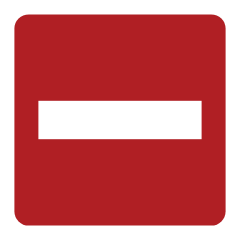
3. A driver hunting for an on-ramp meets this sign at the mouth of the pavement ahead. What is the correct action?
Show answer
Answer C: Keep out of that roadway and look for the proper approach elsewhere
The restriction is absolute and does not depend on how much traffic is present, so the driver has to reach the highway by an approach built for entering vehicles.
-
4. You want to pass on a two-lane road where several people are walking on the narrow shoulder ahead. What should you consider?
Show answer
Answer D: There is no escape room if the pass goes wrong, so wait for a better place
A pass depends on having somewhere to go if it goes wrong, and a shoulder occupied by pedestrians removes that option for both vehicles.
-
5. On a rural road, the driver of a slow farm tractor ahead of you signals a left turn even though there is no road or driveway in sight. What should you do?
Show answer
Answer B: Stay behind the tractor, because it may be turning into a field entrance
Farm equipment often turns into fields through gaps you cannot see, and it may swing wide to do so. Passing a vehicle that is signaling a left turn is a common cause of crashes.
-
6. A ball rolls into the street from between parked cars ahead of you. What should you expect and do?
Show answer
Answer A: Expect a child to follow it and be ready to stop
A ball is usually followed by a child who is watching the ball and not the traffic. Slow down and be prepared to stop immediately.
-
7. Why is an inexperienced rider a poor choice to lead a group?
Show answer
Answer C: The leader picks the pace, the gaps and the hazards for everyone behind
Every decision the leader makes is imposed on the riders behind, so leading demands more traffic judgment than any other position in the group.
-
8. How should cargo be carried on a motorcycle?
Show answer
Answer D: Kept low, in saddlebags or at about seat level
Keeping the load low preserves the center of gravity and the normal handling of the motorcycle, while a high load makes it top heavy and unstable.
-
9. What matters most about the armor built into a riding jacket?
Show answer
Answer B: That it sits over the joints and stays there during a fall
Armor only works where it is, so the jacket must fit closely enough that the pads stay over the shoulders, elbows and spine when the rider hits the ground.
-
10. With the engine off, a rider turns the handlebars fully to the left and to the right. What is being checked?
Show answer
Answer A: That the steering moves freely and no cable is pinched or binding
Cables and wiring that catch at full lock can hold the throttle open or stiffen the steering exactly when the rider needs a tight turn.
-
11. A flashing red arrow is displayed for your turning lane. What does it require?
Show answer
Answer D: Stopping, then turning when the way is clear
A flashing red arrow is treated like a stop sign for that movement: come to a full stop, then turn when it is safe and no one has to be cut off.
-
12. How should braking and swerving be combined?
Show answer
Answer C: Brake before or after the swerve, never during it
Traction can be spent on turning or on braking, and asking for both at once during a swerve is very likely to cause a skid.
-
13. You face a red light at an intersection that has no stop line and no marked crosswalk. Where must you stop?
Show answer
Answer C: Before entering the intersection
With no line and no crosswalk, the stopping point is the near edge of the intersecting roadway, close enough to see cross traffic but clear of it.
-
14. A sign with a black legend on a fluorescent pink background is used for
Show answer
Answer A: traffic incident management
Fluorescent pink is set aside for signing that manages traffic around a crash, a spill or another unplanned incident, so it stands apart from routine work zone orange.
-
15. What happens when tires are driven underinflated for a long time?
Show answer
Answer D: They wear at the edges, they run hot and they are more likely to fail
An underinflated tire flexes too much, which wears the shoulders and builds up heat that can destroy the tire.
-
16. Your passenger has ridden on other people's motorcycles before. What should you do before setting off?
Show answer
Answer A: Brief them anyway, because your machine and your instructions differ
Handholds, footrests, exhaust position and the signals a rider uses all vary from machine to machine, so every passenger is briefed on the machine they are about to ride on.
-
17. What is the correct swerving technique?
Show answer
Answer D: Press the handgrip on the side you want to go and look toward the escape route
A swerve is two quick countersteering inputs, and because the motorcycle goes where the rider looks, the eyes belong on the open space.
-
18. Why is following distance measured in seconds rather than in car lengths?
Show answer
Answer A: Because a time gap automatically grows with speed, while a fixed number of car lengths does not
A gap counted in seconds keeps the same margin of reaction time at any speed, whereas a fixed number of car lengths becomes far too small as speed rises.
-
19. What should a pre-ride check of the drive chain or belt look for?
Show answer
Answer C: Correct slack, adequate lubrication and no worn or damaged links
A chain that is too tight, too loose, dry or damaged can break or jump the sprocket and lock the rear wheel while the motorcycle is moving.
-
20. A United States numbered route is normally marked with
Show answer
Answer C: black numerals on a white shield
The U.S. route marker is a white shield carrying black numerals, which sets it apart at a glance from the red, white and blue Interstate shield.
-
21. You arrive at a four-way stop after two other vehicles have already stopped there. When is it your turn?
Show answer
Answer A: After both of the earlier vehicles have gone
Vehicles clear a four-way stop in the order they arrived, so the third driver to stop is the third to go.
-
22. A clutch cable adjusted with no free play at all causes what problem?
Show answer
Answer B: The clutch may slip and never fully engage
Without a small amount of slack the release mechanism keeps a light load on the plates, so they slip instead of transmitting full power.
-
23. An orange sign reading END ROAD WORK is posted beside the highway. What does it mark?
Show answer
Answer C: The point where the work zone restrictions stop
The sign is installed at the downstream end of the temporary traffic control zone to tell drivers that normal conditions apply again.
-
24. You are riding at 30 miles an hour and need to move quickly to the left. What do your hands do?
Show answer
Answer D: Press forward on the left handgrip
Above a walking pace a motorcycle turns by leaning, and pressing forward on the grip on the side you want to go is what starts the lean.
-
25. You are traveling beside a solid white lane line. What does it tell you?
Show answer
Answer B: Crossing it is discouraged or prohibited, so stay in your lane
A solid white line separates lanes going the same direction where lane changing is discouraged or prohibited, such as where a through lane meets a mandatory turn lane.