
New Hampshire NH DMV Permit Practice Test 28
- Questions40
- Correct to pass32
- Passing score80%
- Minimum age16 years
-
1. Your green left-turn arrow goes out and a steady green ball stays lit. What may you do?
Show answer
Answer A: Continue turning left, but only after yielding to oncoming traffic
When the arrow ends and a green ball remains, the turn changes from protected to permissive, so it is still allowed but oncoming traffic goes first.
-
2. A train has just cleared a crossing that carries two sets of tracks. What should you do?
Show answer
Answer B: Wait and look both ways for a second train
A passing train hides a second train on the other track, so wait until the signals stop and you can see that both tracks are clear.
-
3. Why is being thrown out of a vehicle in a crash so dangerous?
Show answer
Answer C: Because you strike the road or other objects at high speed, and rarely survive
Ejection is one of the deadliest outcomes of a crash, and a fastened belt is what keeps a person inside the vehicle.
-
4. Your right wheels drop off the edge of the pavement onto a soft shoulder. What should you do?
Show answer
Answer C: Ease off the accelerator, hold the wheel straight and steer back gently once you have slowed
Yanking the wheel while the tires are pressed against a pavement lip can throw the vehicle across the road, so slow down first and then make a gentle correction.
-
5. The road is icy and visibility is poor, but you are driving at the posted speed limit. Is this acceptable?
Show answer
Answer A: No, because you may never drive faster than is safe for the conditions
Under the basic speed rule a driver must travel at a speed that is reasonable for the actual conditions, so a legal posted speed can still be an unlawful and unsafe speed.
-
6. Besides school signing, which warning signs may also use a fluorescent yellow-green background?
Show answer
Answer C: Pedestrian and bicycle warning signs
Pedestrian crossing, bicycle and playground warning signs may use either the standard yellow or the fluorescent yellow-green background, which draws extra attention where people outside vehicles are present.
-
7. You are about to descend a long steep grade. How should you control your speed?
Show answer
Answer D: Select a lower gear before starting down and use the brakes in firm, brief applications
Engine braking in a lower gear carries most of the load down the grade, while continuous brake pressure overheats the brakes and reduces their effectiveness.
-
8. You are passing a tractor-trailer on a wet freeway and its wheels throw heavy spray. What is the best technique?
Show answer
Answer B: Increase your wipers and pass steadily without hesitating
Spray blinds you for as long as you stay beside the truck, so prepare the wipers first and then spend as little time in the spray as possible.
-
9. Why is wearing headphones over both ears a problem while driving?
Show answer
Answer D: You may not hear horns, sirens or other warning sounds
Hearing is part of your awareness of traffic. Covering both ears blocks emergency sirens, horns and the sound of an approaching vehicle you cannot yet see.
-
10. You want to turn right from a lane marked for through traffic and right turns, and the driver behind you wants to go straight. What should you do?
Show answer
Answer C: Signal, stay in the lane and make the turn when it is safe
A shared lane is the correct place to turn right from, so signal early and turn from the lane; the driver behind must wait or use another lane.
-
11. What must the classroom part of a New Hampshire approved driver education course include?
Show answer
Answer B: 45 minutes on motorcycle safety and 45 minutes on tractor-trailer awareness
RSA 263:19 requires the 30 classroom hours to include 45 minutes of an approved motorcycle safety course and 45 minutes of an approved tractor-trailer safety and awareness course.
-
12. A tow truck with flashing amber lights is loading a car on the shoulder ahead. How should you treat it?
Show answer
Answer B: Give it the same room as an emergency vehicle
Tow operators, utility crews and highway workers face the same danger from passing traffic, so move over or slow down for their flashing amber lights too.
-
13. Traffic is backed up beyond a railroad crossing. When may you start across the tracks?
Show answer
Answer B: Only when there is room for your whole vehicle on the far side
Never enter a crossing you cannot clear; a vehicle stopped on the tracks in a queue has nowhere to go if the signals start.
-
14. A yellow diamond showing two vertical arrows, one pointing up and one pointing down, warns that
Show answer
Answer A: the road ahead carries traffic in both directions
The two-way traffic sign warns that the roadway ahead is not divided and that vehicles will be coming from the opposite direction.
-
15. When should you arrange your way home if you plan to drink?
Show answer
Answer C: Before the first drink
Judgment is the first thing alcohol weakens, so the plan has to be made while you can still make a good one.
-
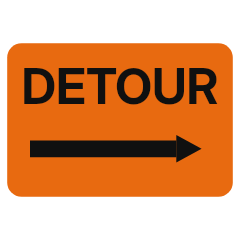
16. Which of these is true of the roadway a driver is being sent onto here?
Show answer
Answer D: Its own signs, signals and speed limits govern for the whole way around
The alternate route is an ordinary public road, so every control posted on it governs as usual; being sent that way grants no extra priority and no relief from the limits in force there.
-
17. On dry pavement in good weather, what is the smallest following gap you should keep?
Show answer
Answer A: About three seconds behind the vehicle ahead
Three seconds is the accepted minimum on dry roads in good visibility, and the gap should be longer in poor conditions.
-
18. Your car has side curtain airbags. What should you avoid doing?
Show answer
Answer B: Resting your head against the window or the door pillar
A side airbag deploys from the pillar or roof rail, so a head leaning against that area is directly in its path.
-
19. You are in the acceleration lane and the gap you were aiming for is now beside you. What is the best adjustment?
Show answer
Answer A: Change your speed a little to line up with a gap, then merge smoothly
The acceleration lane is for matching both the speed and the position of a gap, and small speed adjustments are what line the two up.
-
20. What can a loose or doubled up floor mat on the driver side cause?
Show answer
Answer A: It can slide forward and trap the accelerator pedal down
An unsecured mat, or a second mat laid over the first, can slip forward and hold the accelerator open. Use the mat clips and never stack mats.
-
21. You are stopped in traffic at a red light when an ambulance comes up behind you with its siren on. What is the correct action?
Show answer
Answer D: Stay put until you can move aside legally and safely
You must not run a red light or make an unsafe move to yield; wait, then pull to the side once the way ahead lets you do it safely.
-
22. Why must you never leave the engine running in a closed garage?
Show answer
Answer B: Because carbon monoxide builds up and can kill within minutes
Exhaust gas contains carbon monoxide, which has no smell or color and can reach fatal levels in an enclosed space very quickly.
-
23. Two roads come together at a shallow angle under a MERGE sign, with no yield line on either one. What is expected of you?
Show answer
Answer D: Adjust your speed and position so you blend smoothly into the other traffic
A merge means neither road ends at a stop; drivers adjust speed and position so that the two streams fit together without stopping.
-
24. When are the hazard warning lights properly used?
Show answer
Answer A: When your vehicle is stopped or barely moving and is a hazard
Hazard lights warn that your vehicle is an obstruction; they do not authorize illegal parking and they hide your turn signals while driving.
-
25. A large X with the letters R and R beside it is painted across your lane. What does it mean?
Show answer
Answer A: A railroad crossing lies a short distance ahead
The pavement marking repeats the advance warning for a grade crossing, and it is used on paved approaches where speeds are high or where gates are installed.
-
26. What does a first violation of the New Hampshire youth operator night or passenger restrictions cost?
Show answer
Answer C: A fine of up to $100 and a suspension of up to 30 days
RSA 263:14 sets a fine of up to $100 and a suspension of up to 30 days for a first violation, rising to $200 and up to 90 days for later ones.
-
27. Snow has covered the pavement markings on a two-lane road. How should a driver judge lane position?
Show answer
Answer B: By the tracks of other traffic and the roadside features
With the markings hidden, ruts left by earlier traffic, signs, poles and the line of the shoulder are the best clues to where the lane runs.
-
28. What does New Hampshire require of someone driving a utility vehicle or an off highway recreational vehicle on a public way?
Show answer
Answer C: A valid driver license, and a way posted at 40 mph or less that is open to it
RSA 265:160 confines these vehicles to ways posted at 40 miles per hour or less, 35 for a compact utility tractor, on routes open to them, and requires the person in control to hold a valid driver license.
-
29. A center lane is bordered by a solid yellow line on the outside and a broken yellow line on the inside, with left-turn arrows painted in it. How may you use that lane?
Show answer
Answer A: Only to make a left turn or to prepare for one from either direction
That marking identifies a two-way left turn lane, which may only be used for left turns or to prepare for a left turn and never for travel or passing.
-
30. A friend who has been drinking insists on driving home. What is the right thing to do?
Show answer
Answer B: Take the keys and arrange a sober ride, even if the friend objects
An impaired driver is dangerous on any street at any speed, and coffee does not lower blood alcohol. Keeping the keys and finding another way home is the only safe choice.
-
31. You are using the parking brake to slow a vehicle whose brakes have failed. How should you apply it?
Show answer
Answer D: Gradually, holding the release so you can let it off if the rear slides
The parking brake works on two wheels only, so applying it hard can lock them and spin the vehicle. Keep the release held so you can back it off instantly.
-
32. Within what time must a New Hampshire license holder tell the director of a change of legal name, permanent residence or mailing address?
Show answer
Answer C: Within 30 days, in writing
RSA 263:9 requires written notice to the director within 30 days of a change of legal name, permanent residence or mailing address.
-
33. Where may a neighborhood electric vehicle be driven in New Hampshire?
Show answer
Answer A: On a way posted at 35 mph or less, and across higher-limit ways at intersections
RSA 265:158 limits a neighborhood electric vehicle to ways posted at 35 miles per hour or less, while allowing it to cross an intersection with a way posted higher.
-
34. A white diamond symbol is painted in a highway lane. What does it identify?
Show answer
Answer C: A lane reserved for high-occupancy vehicles
The diamond symbol marks a preferential lane, most often one reserved for vehicles carrying a minimum number of occupants.
-
35. How does a wet road change the distance you need to stop?
Show answer
Answer C: It lengthens it, so you need a much bigger gap ahead
Water between the tire and the road cuts grip, so braking distance grows and the gap that works on dry pavement is no longer enough.
-
36. You have a green light at a school crossing, but the crossing guard steps out and holds up a stop sign toward you. What must you do?
Show answer
Answer A: Stop, because the crossing guard controls this crossing and outranks the signal
Directions from a crossing guard or a police officer take priority over signals and signs.
-
37. What is a good rule for any task you want to do inside the vehicle?
Show answer
Answer D: If it needs more than a moment, do it stopped
A glance of a second or two is manageable, but any task that runs longer belongs to a stopped vehicle, because the road does not pause while you do it.
-
38. May you exceed the posted speed limit in order to complete a pass?
Show answer
Answer C: No, the posted limit applies while you are passing too
The limit does not lift for passing; if you cannot complete the pass within it, there is not enough room and you should stay back.
-
39. How should you position your vehicle for a right turn from a two-way street?
Show answer
Answer B: As close as practical to the right curb or edge, then turn into the nearest right lane
Right turns are made from the lane nearest the right edge into the nearest available lane, which keeps the turn tight and prevents a wide sweep into other traffic.
-
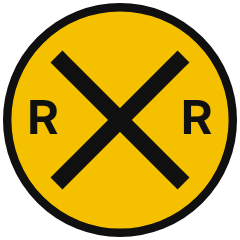
40. A driver sees this sign on a quiet road with no other traffic in either direction. What is the correct response?
Show answer
Answer C: Slow down, look and listen for a train, and be ready to stop
The sign gives advance notice of a highway-rail grade crossing, so the driver reduces speed, checks both directions along the tracks and keeps enough room to stop short of the rails.