
New Hampshire NH DMV Permit Practice Test 21
- Questions40
- Correct to pass32
- Passing score80%
- Minimum age16 years
-
1. Why should you make sure your turn signal has stopped flashing after a lane change?
Show answer
Answer A: A signal left flashing tells other drivers that you intend to move again
Other drivers act on your signals, so one that is left on gives them false information about what you are about to do.
-
2. You are passing a large truck on an open highway in a strong crosswind. What should you expect?
Show answer
Answer A: A push toward the truck, then a push the other way as you clear it
The truck shelters you as you go by and then releases you into the full gust, so the load on the steering changes twice during the pass.
-
3. At 45 mph you look at a navigation screen for four seconds. Roughly how far do you travel unseeing?
Show answer
Answer D: About 260 feet
At 45 mph you cover roughly 66 feet a second, so four seconds on a screen is around 260 feet of road that you never looked at.
-
4. How often should you check your mirrors while driving?
Show answer
Answer C: Every few seconds, so you always know what is around you
Traffic behind and beside you changes constantly. Frequent, brief mirror checks keep a picture of your surroundings current so nothing surprises you.
-
5. Is dictating a message by voice a safe alternative to typing one?
Show answer
Answer C: No, it still takes attention from driving
Composing and checking a spoken message loads the mind and usually pulls the eyes to the screen anyway, so research finds it no safer than other phone use.
-
6. You are making a legal U-turn at an intersection. Who has the right of way?
Show answer
Answer C: Everyone else, until your turn is complete
A U-turn crosses several paths at once, so you yield to oncoming vehicles, to crossing traffic and to pedestrians before starting it.
-
7. How many demerit points does New Hampshire assess for a conviction under RSA 263:1, driving without the required license?
Show answer
Answer C: 4 points
Driving without the required driver license is a four-point conviction in New Hampshire, while merely failing to produce a license for an officer is worth two.
-
8. A loaded truck is coming up an entrance ramp as you approach in the right lane of the freeway. What is the most helpful action?
Show answer
Answer A: Adjust your speed to open a gap for it
A heavy vehicle accelerates slowly, so opening a gap or moving over costs you seconds and saves the truck driver from being forced to stop on the ramp.
-
9. A New Hampshire driver with no prior record submits to a test that discloses 0.08. What administrative suspension does the department impose?
Show answer
Answer A: Six months
RSA 265-A:30 requires a six-month administrative suspension when a first test discloses 0.08 or more and there is no prior refusal, conviction or administrative suspension.
-
10. Why is it risky to brake hard and steer sharply at the same moment?
Show answer
Answer C: The tires have a limited amount of grip that braking and turning must share
Each tire can deliver only so much grip, and asking it to slow the vehicle and change direction at once can exceed that limit and start a skid.
-
11. At what tread depth should a tire be replaced?
Show answer
Answer A: When the tread is worn down to 2/32 of an inch
At that depth a tire loses grip quickly, especially on wet roads, and the built in wear bars or the penny test both show when the point has been reached.
-
12. You are hosting a party and a guest who has been drinking wants to drive home. What should you do?
Show answer
Answer D: Stop serving and arrange a ride or a bed
Only time removes alcohol, so a host who wants to prevent a crash has to remove the driving, not try to speed up sobering that cannot be sped up.
-
13. You are driving through a neighborhood where several children are riding bicycles. What should you do?
Show answer
Answer C: Slow down and expect sudden, unpredictable moves
Young riders lack the judgment and the mirror habits of adults and may swerve or cross without looking, so lower speed is your only reliable margin.
-
14. A flashing red lamp is mounted above a stop sign at a rural intersection. What does it add?
Show answer
Answer C: Emphasis, while the required stop stays the same
A stop beacon makes an easily missed stop sign more visible, but it neither adds to nor takes away from the obligation the sign already imposes.
-
15. The curb ahead is signed as a bus stop. May you wait there with your vehicle?
Show answer
Answer C: No, the space must stay clear for buses
A bus stop must stay open so that a bus can reach the curb and let passengers on and off safely, so no other vehicle may occupy it.
-
16. What should a driver expect a short distance beyond this sign?
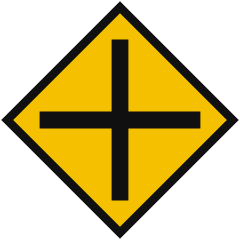
Show answer
Answer C: Another road crossing the one being traveled
Traffic may enter or cross from either side at the intersection ahead, so the driver should ease off, cover the brake and check both approaches.
-
17. What night driving restriction applies to a New Hampshire Youth Operator License holder under 18?
Show answer
Answer C: No driving between 1:00 a.m. and 4:00 a.m.
A New Hampshire Youth Operator License holder under 18 may not operate a motor vehicle between 1:00 a.m. and 4:00 a.m.
-
18. Your car begins to lose power on a freeway and you must stop. Where should you try to bring it to a halt?
Show answer
Answer A: As far off the right side of the road as you can get, beyond the edge line
A disabled vehicle should be moved completely clear of the travel lanes, on the right, so that traffic can pass without changing course.
-
19. A large electronic advertising sign beside the road catches your eye. What should you do?
Show answer
Answer A: Glance briefly and return your eyes to the road
Bright changing displays are designed to hold attention, so treat them like any roadside object and give them no more than a brief glance.
-
20. A snow squall cuts visibility to almost nothing while you are on a highway. What must you not do?
Show answer
Answer D: Stop in a travel lane and wait for the squall to blow through
A vehicle stopped in a lane in a whiteout is invisible until someone hits it. Slow gradually and keep moving until you can leave the roadway completely.
-
21. Some toll facilities use signs and markings with a purple background or a purple stripe. What do they identify?
Show answer
Answer D: Lanes reserved for vehicles with an electronic toll account
Purple is assigned to lanes and ramps restricted to vehicles with a registered electronic toll collection account, so drivers without one must stay out.
-
22. Why would this sign be installed on an approach?
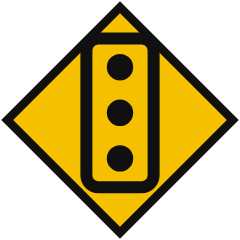
Show answer
Answer B: Because the signal cannot be seen from far enough back for a driver to react in time
Advance notice of a signal is used where a crest, a curve, trees or a building keep the signal heads out of view until a driver is already too close to stop comfortably.
-
23. How does alcohol change the time a driver needs to respond to a hazard?
Show answer
Answer A: It slows it, so stopping takes longer
Alcohol is a depressant that lengthens the time between seeing a hazard and acting on it, which adds directly to the distance needed to stop.
-
24. Which passenger situation makes a New Hampshire impaired driving offense an aggravated one?
Show answer
Answer C: Carrying a passenger who is under 16 years of age
RSA 265-A:3 treats carrying a passenger under the age of 16 as an aggravating circumstance for driving while intoxicated.
-
25. A New Hampshire driver whose license was revoked for driving while intoxicated has it reissued. What standard then applies to that license?
Show answer
Answer C: An alcohol concentration of 0.03 or more is a per se violation, for at least 5 years
RSA 265-A:35 makes such a license probationary for at least 5 years and treats an alcohol concentration of 0.03 or more as a per se violation of it.
-
26. The cars in front of and behind your parallel parked car have left you very little room. How do you get out?
Show answer
Answer D: Ease back and forth, turning the wheels each way, until you clear
Short movements with the wheels turned first one way and then the other walk the car out of a tight space without touching anything.
-
27. The light turns yellow when your front wheels are already past the stop line inside the intersection. What should you do?
Show answer
Answer B: Keep going and clear the intersection without speeding up
Once you are legally in the intersection the safest and correct action is to continue through and clear it, without accelerating.
-
28. The vehicle in front of you has stopped and is waiting to turn left, and there is a paved shoulder to the right. May you use it to get by?
Show answer
Answer D: No, in most states a pass may not be made by leaving the paved travel lanes
Passing on the right is normally lawful only inside the marked travel lanes, and most states prohibit driving onto the shoulder to get around a turning vehicle; the few states that allow it attach strict conditions.
-
29. You leave a brightly lit service area onto a dark rural road. Why should you slow down for a while?
Show answer
Answer C: Your eyes need time to adjust, so at first you see less
Eyes take a few minutes to adapt from bright light to darkness, and during that time you can see much less than your headlights actually show.
-
30. Besides motorist services and tourist information, a blue sign background is also used for
Show answer
Answer B: evacuation route signing
Blue is assigned to road user services, tourist information and evacuation routes, so hurricane and other evacuation routes are signed in blue.
-
31. You arrive at a four-way stop after two other vehicles have already stopped there. When is it your turn?
Show answer
Answer A: After both of the earlier vehicles have gone
Vehicles clear a four-way stop in the order they arrived, so the third driver to stop is the third to go.
-
32. A yellow diamond showing the silhouette of a deer warns that
Show answer
Answer D: large animals may cross the road in that area
The sign marks a stretch where animals are known to cross, so drivers should reduce speed and scan both roadsides, especially around dawn and dusk.
-
33. A signal beside a fire station stays dark until apparatus is about to leave, when it shows yellow and then red. What must a driver do?
Show answer
Answer B: Stop on the red and wait until the signal goes dark again
An emergency vehicle signal is a real traffic signal, so its red indication must be obeyed while the apparatus pulls out into the street.
-
34. Low sun is shining onto the signal ahead and you cannot tell which light is lit. What should you do?
Show answer
Answer D: Slow down and be ready to stop until you can be sure
An unreadable signal has to be treated as one that may be red, so approach slowly enough to stop while you work out what it shows.
-
35. Is it acceptable to leave your vehicle across the entrance of an alley for a short time?
Show answer
Answer A: No, the entrance must stay clear at all times
Blocking an alley entrance traps the vehicles inside and can keep emergency services out, so it is prohibited however brief the stop.
-
36. A driver on the street this sign governs is preparing to turn left at the next corner. Which lane should the vehicle be in beforehand?
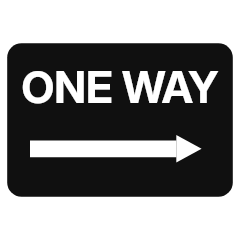
Show answer
Answer A: The lane closest to the left curb
All the traffic here runs the same way, so nothing is coming toward the driver and the turn is taken from the extreme left lane rather than from beside the middle of the roadway.
-
37. You are stopped inside an intersection waiting for a gap to turn left. How should your front wheels be positioned?
Show answer
Answer C: Pointing straight ahead until you actually begin the turn
If your wheels are already turned left and another vehicle strikes you from behind, you would be pushed into oncoming traffic.
-
38. Which practice matches current child passenger safety guidance?
Show answer
Answer D: Keep a child rear facing until the top height or weight limit of the seat is reached
A rear facing seat spreads crash forces across the child's whole back, so it should be used as long as the seat allows, and never in front of an active passenger air bag.
-
39. The red brake warning light stays on after you release the parking brake. What should you do?
Show answer
Answer D: Stop safely and have the brakes checked before driving on
With the parking brake released, that light points to low fluid or a fault in one half of the braking system, which can leave you with very little braking.
-
40. May you stop briefly across the sloped ramp that joins the sidewalk to the street at a corner?
Show answer
Answer B: No, that ramp must stay clear for people using wheelchairs
A curb ramp is the only way many people can get from the sidewalk to the crosswalk, so blocking it even briefly is prohibited.