
New Hampshire NH DMV Motorcycle Practice Test 7
- Questions25
- Correct to pass20
- Passing score80%
- Minimum age16 years
-
1. Visibility drops suddenly and you decide to leave the highway. What is the safest way to do it?
Show answer
Answer A: Take the next exit or a wide pull off, well clear of the traffic lanes
Get right off the traveled way, and off the shoulder too if you can, because vehicles in poor visibility often drift onto the shoulder.
-
2. You are driving on the through road of a T-intersection and want to turn left into the side road. Oncoming traffic is approaching on the through road. What must you do?
Show answer
Answer C: Yield to the oncoming traffic before you turn
The vehicle waiting in the stem of the T yields to both of you, but you still owe the right of way to oncoming through traffic before turning across it.
-
3. In heavy stop-and-go traffic, why does using both lanes right up to a merge point help?
Show answer
Answer D: It stores the queue in two lanes, so the backup is shorter
Filling both lanes halves the length of the queue and keeps it away from the traffic upstream, which is why alternating at the merge point works better when traffic is slow.
-
4. How often should a rider change position within the lane?
Show answer
Answer C: As often as the traffic, the road surface and the hazards around you change
Lane position is a tool for keeping space and visibility, and both of those change constantly as traffic and road conditions change.
-
5. What is the usual result of driving well above the flow of traffic on a typical trip?
Show answer
Answer B: Very little time saved, with much greater risk
Signals, traffic and short distances swallow the theoretical gain, while crash risk and crash severity both climb sharply with speed.
-
6. The vehicle in front of you has stopped and is waiting to turn left, and there is a paved shoulder to the right. May you use it to get by?
Show answer
Answer D: No, in most states a pass may not be made by leaving the paved travel lanes
Passing on the right is normally lawful only inside the marked travel lanes, and most states prohibit driving onto the shoulder to get around a turning vehicle; the few states that allow it attach strict conditions.
-
7. On a two-lane road with a broken yellow center line, may you cross it to turn into a driveway on the left?
Show answer
Answer C: Yes, when it is safe and the oncoming lane is clear
A broken center line may be crossed for a pass or for a left turn into a road or a driveway, once the oncoming lane is clear.
-
8. A pedestrian near the curb is staring at a phone and not looking at traffic. What should you do?
Show answer
Answer A: Slow down and be ready to stop, because the pedestrian may step out without looking
Distracted pedestrians step into the street without checking. Assume they have not seen you and give yourself time and space to stop.
-
9. Someone appears seriously injured after a crash. What should you generally do?
Show answer
Answer C: Call for emergency help and avoid moving the person unless there is an immediate danger such as fire
Moving an injured person can worsen spinal or internal injuries, so summon trained help and leave the person in place unless staying there is more dangerous than moving.
-
10. You and the driver facing you both have stop signs at a two-way stop. You are going straight and that driver is turning left. Who has the right of way?
Show answer
Answer B: You do, and the turning driver must wait
Between two opposing drivers who both stopped, the one going straight goes first and the left-turning driver yields.
-
11. A yellow sign ahead of an underpass reads LOW CLEARANCE 12 FT 6 IN. What does the figure tell you?
Show answer
Answer B: The greatest height that can pass beneath the structure
The figure is the actual clearance available, so a vehicle taller than that must leave the road and take a marked alternative route.
-
12. You have just driven through a deep puddle and your brakes feel weak. What should you do?
Show answer
Answer D: Drive slowly while lightly applying the brakes until they dry and work normally
Wet brakes grip poorly and may pull to one side. Gentle braking at low speed generates heat that dries the pads and discs quickly.
-
13. How may a two-way left-turn lane never be used?
Show answer
Answer B: As a through travel lane or a passing lane
The lane exists only for turning movements, so traveling or passing along it puts you head-on with vehicles turning from the opposite direction.
-
14. Why should a rider pull in the clutch at the first sign that the engine is seizing?
Show answer
Answer B: So a locking engine cannot lock the rear wheel through the drive train
A seizing engine can lock up, and with the clutch engaged that would lock the rear wheel, so disconnecting the drive keeps the wheel rolling while you coast off the road.
-
15. Where must a New Hampshire driver stop at a railroad grade crossing that carries a stop sign ordered by the commissioner of transportation?
Show answer
Answer A: Within 50 feet but not less than 15 feet from the nearest rail
RSA 265:49 requires a driver facing such a stop sign to stop within 50 feet but not less than 15 feet from the nearest rail and to proceed only after exercising due care.
-
16. You are traveling at 55 mph on a rural road and come up behind a horse-drawn buggy. What is the main danger?
Show answer
Answer D: You close on it very quickly because it moves at walking pace
A buggy travels only a few miles an hour, so the gap closes far faster than drivers expect and there is very little time to brake once you see it.
-
17. A traffic signal is displaying a flashing red light. How must you treat it?
Show answer
Answer D: Stop completely, then proceed when the way is clear
A flashing red carries the same meaning as a stop sign: come to a full stop, then go only when it is safe.
-
18. How should a passenger behave through a turn?
Show answer
Answer B: Look over the operator's shoulder in the direction of the turn and avoid sudden movement
Looking over the operator's shoulder into the turn keeps the passenger aligned with the motorcycle, and avoiding sudden movement prevents unexpected changes in balance.
-
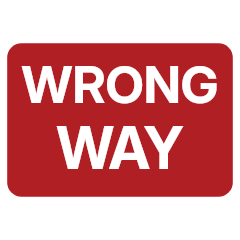
19. At a freeway exit ramp, this sign normally backs up which other regulatory sign posted nearer to the ramp terminal?
Show answer
Answer D: The sign that forbids entering that roadway at all
The two work as a pair at ramp terminals: one keeps drivers from turning in, and this one sits farther along to catch a driver who has already entered.
-
20. Why can a mild afternoon still chill a rider dangerously on the highway?
Show answer
Answer B: Riding speed creates a wind chill well below the air temperature
Air moving over the body at highway speed strips heat far faster than still air, so a comfortable temperature at a standstill can cause serious chilling in an hour of riding.
-
21. Where should a rider in the middle of a group direct their attention?
Show answer
Answer A: Well ahead through the group and around it, not just at the rider in front
Watching only the machine ahead hides the traffic and hazards further up the road, and it leaves the rider reacting late to everything the group meets.
-
22. Why should a rider reduce speed at night even on a familiar road?
Show answer
Answer C: So the stopping distance stays inside the distance the headlight lights up
At night you can only react to what the headlight shows, so keep your speed low enough that you can stop within the lit distance ahead.
-
23. What is the correct position for the feet while riding?
Show answer
Answer C: Firmly on the footrests with the toes level
Toes kept level stay clear of the pavement when the motorcycle leans and leave the foot ready to reach the brake pedal or shift lever.
-
24. Where do the greatest number of collisions involving motorcycles occur?
Show answer
Answer D: At intersections
Intersections concentrate crossing and turning paths, and the most common single event is a car turning left across the path of an oncoming motorcycle.
-
25. A yellow diamond shows two lanes narrowing into one. What does it require of a driver?
Show answer
Answer D: Adjusting speed and merging before the lane disappears
The lane ends sign gives notice that one lane will be dropped, so drivers should adjust speed and blend into the continuing lane in good time.