
New Hampshire NH DMV Motorcycle Practice Test 41
- Questions25
- Correct to pass20
- Passing score80%
- Minimum age16 years
-
1. You reach the end of the acceleration lane and there is still no gap in the traffic. What should you do?
Show answer
Answer B: Slow down and merge behind the traffic rather than forcing your way in
Merging behind the traffic costs you only a little speed, while forcing into a space that is not there puts you alongside a vehicle with nowhere to go.
-
2. You notice at night that one of your headlights has burned out. What should you do?
Show answer
Answer B: Get it replaced promptly, because other drivers may take you for a motorcycle
A single light makes your vehicle look narrower and further away, so other drivers misjudge you, and one light is also illegal.
-
3. A driver has to stop for a train at this sign. How far back from the nearest rail should the vehicle be held?

Show answer
Answer C: No closer than roughly fifteen feet
A train and its load overhang the rails, so stopping no closer than about fifteen feet keeps the vehicle outside the space the train actually sweeps.
-
4. You arrive at an intersection with no signs, no signals and no markings at the same time as a vehicle on the road to your right. What must you do?
Show answer
Answer B: Yield to the vehicle on your right
At an uncontrolled intersection you must yield to a vehicle already in the intersection or approaching from your right.
-
5. Your lane is ending ahead in slow, heavy traffic and drivers in the next lane are already bumper to bumper. What is the recommended way to merge?
Show answer
Answer C: Take turns, one vehicle from each lane at the merge point
Alternating one for one at the merge point keeps both lanes moving and is the safest way to combine slow traffic.
-
6. How does a NO OUTLET sign differ from a DEAD END sign?
Show answer
Answer B: It warns that a whole group of streets has no way out
No Outlet is posted where the road leads into a network of streets from which there is no through route, while Dead End refers to the single street itself.
-
7. In a work zone the temporary lane lines conflict with the old lines still visible on the pavement. Which do you follow?
Show answer
Answer C: The temporary markings, which show the current traffic pattern
Temporary markings define the traffic pattern in force, and the old lines are simply the layout that no longer applies.
-
8. Which quality matters most in a face shield?
Show answer
Answer B: It resists penetration and is free of deep scratches
A shield has to stop objects thrown up from the road and stay clear enough for undistorted vision, and it needs some airflow so that it does not fog.
-
9. Where is passing prohibited even when no line is visible?
Show answer
Answer D: On a curve or near the crest of a hill, at intersections and at railroad crossings
Passing is prohibited wherever your view of oncoming traffic is blocked or where vehicles may cross your path, which includes hills, curves, intersections and rail crossings.
-
10. At what alcohol concentration does a New Hampshire driver commit aggravated driving while intoxicated on that figure alone?
Show answer
Answer D: 0.16 or more
RSA 265-A:3 makes an alcohol concentration of 0.16 or more aggravated driving while intoxicated without any additional circumstance.
-
11. In a staggered formation, where does the second rider belong?
Show answer
Answer C: In the right portion of the lane, about one second behind the leader
The second rider uses the opposite side of the lane roughly one second behind the leader, which staggers the group without stretching it out or putting the two riders alongside each other.
-
12. What does a broken line indicate, whatever color it is painted?
Show answer
Answer C: That crossing it is permitted
A broken line always describes a permissive condition, and the color then tells the driver whether the traffic beyond it runs the same way or the opposite way.
-
13. At a four-way stop you and an opposing driver arrive together. You are going straight and the other driver is turning left across your path. Who goes first?
Show answer
Answer B: You do, because the left turn crosses your path
When two opposing drivers arrive together, the one going straight goes first and the left-turning driver yields.
-
14. You are at a red light where right turns on red are allowed, you cannot see clearly, and the driver behind sounds the horn. What should you do?
Show answer
Answer C: Stay stopped until you can see that the turn is safe
Turning right on red is permitted, never required, so you wait until you can see that the way is clear no matter what the driver behind does.
-
15. A large electronic advertising sign beside the road catches your eye. What should you do?
Show answer
Answer A: Glance briefly and return your eyes to the road
Bright changing displays are designed to hold attention, so treat them like any roadside object and give them no more than a brief glance.
-
16. Why should reflective material be placed on the front, back and sides of a rider's gear?
Show answer
Answer D: A driver may approach the rider from any of those directions
Threats come from ahead, behind and from the sides at intersections, so reflective material should be visible from every direction a vehicle can approach.
-
17. Why does this warning matter more on a motorcycle than in a car?
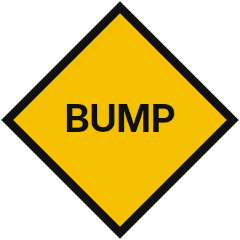
Show answer
Answer B: Because a sudden jolt can unsettle a two-wheeled machine and the rider can lose control
A jolt can push a motorcycle off line or lift a wheel, so a rider slows early, comes slightly off the seat and keeps a relaxed but firm hold on the handlebars.
-
18. How should tire pressure be checked and set?
Show answer
Answer B: When the tires are cold, set to the pressure specified by the vehicle manufacturer
Driving heats the air and raises the reading, and the sidewall number is a maximum rather than a recommendation, so check cold and use the figure on the vehicle placard or in the owner's manual.
-
19. Traffic is heavy and crawling where a sign warns that your lane ends and two lanes must become one. What is the best practice?
Show answer
Answer C: Use the lane to the end, then take turns merging one by one
In stop-and-go traffic the zipper merge, using both lanes up to the merge point and then alternating, keeps the queue shorter and traffic moving; in free-flowing traffic move over as soon as it is safe.
-
20. Why do experienced riders squeeze the clutch lever while starting the engine, even with the neutral light showing?
Show answer
Answer A: In case a gear is engaged, so the motorcycle cannot lurch forward
A neutral light can be wrong, and a disengaged clutch means the machine stays still even if the transmission is actually in gear.
-
21. An overhead lane-use control signal shows a steady red X above your lane. What does it mean?
Show answer
Answer B: You may not use that lane and must move out of it
A steady red X means the lane below it is closed to you, while a steady yellow X is the warning to prepare to vacate the lane and a downward green arrow means the lane is open.
-
22. When should a rider add a layer on a ride that is turning cold?
Show answer
Answer D: Before you start to feel cold, at the next convenient stop
Once a rider is chilled it takes a long time to warm up again, and cold hands and slowed reactions cost control, so add layers before the cold takes hold.
-
23. How much more energy must your brakes absorb if you double your speed?
Show answer
Answer D: About four times as much, since energy rises with the square of speed
Kinetic energy grows with the square of speed, so twice the speed means about four times the energy and a far longer braking distance.
-
24. A turn restriction sign at the corner shows a range of times below the symbol. What does that mean?
Show answer
Answer A: The turn is banned only during the hours shown on the sign
Times posted under a regulatory symbol set the period during which the restriction applies; outside those hours the movement is permitted.
-
25. Why is parking next to a fire hydrant or in a marked fire lane prohibited?
Show answer
Answer D: It would delay firefighters who need immediate access to the hydrant or the building
Fire hydrants and fire lanes must remain clear at all times so emergency crews can connect hoses and reach a building without delay.