
New Hampshire NH DMV Motorcycle Practice Test 30
- Questions25
- Correct to pass20
- Passing score80%
- Minimum age16 years
-
1. Why should a rider avoid painting a helmet or cleaning it with strong solvents?
Show answer
Answer D: Chemicals can weaken the shell and the liner without showing it
Solvents and some paints attack the shell and the foam, so use mild soap and water and follow the maker's instructions to keep the helmet's protection intact.
-
2. Lights set into the pavement along both edges of a crosswalk start to flash yellow as you approach. What do they tell you?
Show answer
Answer D: Someone is crossing and has to be given way
In-roadway warning lights flash only when a pedestrian activates the crossing, so a flashing pattern means somebody is in or entering the crosswalk.
-
3. You are starting from a stop on a snowy, icy street and the drive wheels begin to spin. What should you do?
Show answer
Answer C: Ease off the accelerator and start again more gently
Spinning tires polish the surface and dig in. Very gentle pressure on the accelerator, and a higher gear if you have one, gives the tires the best chance to grip.
-
4. How much should you normally reduce your speed on a road covered with packed snow compared with dry conditions?
Show answer
Answer C: By about half
Packed snow roughly doubles the distance needed to stop, so a common guideline is to cut speed by about half. On ice, slow to a crawl.
-
5. At an intersection where turning on a red arrow is not permitted, the signal shows a red left arrow next to a steady green ball. What may you do?
Show answer
Answer D: Go straight or turn right if permitted, but not left
An arrow controls only the movement it points to, so here the red arrow stops the left turn while the green ball still allows the other movements.
-
6. A train has just cleared a crossing that carries two sets of tracks. What should you do?
Show answer
Answer B: Wait and look both ways for a second train
A passing train hides a second train on the other track, so wait until the signals stop and you can see that both tracks are clear.
-
7. You have driven at 70 mph for an hour and then exit onto a town street. What is the common risk?
Show answer
Answer B: Your sense of speed adapts, so 35 mph feels slow and you drive too fast
After a long stretch at high speed the brain adapts, so town speeds feel unnaturally slow; check the speedometer instead of trusting the feeling.
-
8. A pedestrian using a white cane or walking with a guide dog starts to cross the street ahead of you. What must you do?
Show answer
Answer A: Yield and stay stopped until the person has finished crossing
A white cane or guide dog identifies a pedestrian who may not be able to see your vehicle, so you must yield and wait rather than maneuver around the person. The horn can confuse the pedestrian or the dog.
-
9. What is wrong with slowing to a crawl at a stop sign and then rolling on through?
Show answer
Answer C: It is not a stop, and you may miss a pedestrian or cross traffic
A rolling stop is a violation and it also cuts short the moment you need in order to look carefully in each direction before entering.
-
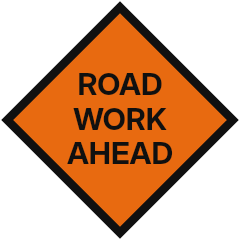
10. How should speed and following distance be adjusted beyond this sign?
Show answer
Answer D: Cut speed and leave a longer gap, because traffic can stop without warning
Traffic in these areas stops and starts unexpectedly and there is little room to steer around a problem, so extra space is what prevents a rear-end collision.
-
11. How should riders in a staggered formation pass another vehicle?
Show answer
Answer D: One rider at a time
Passing one rider at a time keeps each pass short and prevents the group from occupying the other lane longer than necessary.
-
12. A bicyclist in the bike lane ahead of you signals and starts to move left toward the turn lane. What should you do?
Show answer
Answer A: Slow down and let the rider move across
A bicyclist who needs to leave the bike lane to turn left is changing lanes like any driver, and following traffic should make room.
-
13. In heavy fog at night on a rural two-lane road, which marking best helps a driver hold position?
Show answer
Answer C: The solid white line along the right edge
Steering by the right edge line keeps a driver clear of oncoming traffic, while watching the center line tends to pull the vehicle toward it.
-
14. Why should riders avoid the center strip of the lane, especially where traffic stops often?
Show answer
Answer A: Because it collects oil and grease dripped from other vehicles
Drippings from other vehicles build up in the center of the lane, and the buildup is heaviest at busy intersections and toll booths where traffic sits waiting.
-
15. What does the traffic law actually say about the right of way?
Show answer
Answer B: It says who must yield; no driver is ever entitled to take the right of way
The law describes who must yield. Right of way is something you give; insisting on it when another driver does not yield causes crashes.
-
16. What does the thick foam liner inside a certified helmet actually do in a crash?
Show answer
Answer C: It crushes so the head slows down over a longer time and distance
The crushable liner is the part that absorbs energy, letting the head decelerate gradually instead of stopping instantly against a hard surface.
-
17. During a pre-ride check, what should the throttle do when it is released?
Show answer
Answer A: Snap back to the closed position on its own
A throttle that does not close by itself can leave the engine running fast when the rider expects it to slow, so a sticking cable must be repaired before riding.
-
18. Why does a long downhill grade lengthen the distance you need to stop?
Show answer
Answer C: Because gravity keeps pulling the vehicle forward as you brake
On a downgrade gravity works with the vehicle and against the brakes, so the same speed needs noticeably more distance than it would on level ground.
-
19. Your passenger wants to carry a bag in one hand during the ride. What should you tell them?
Show answer
Answer B: No, both hands are needed to hold on, so the bag must be secured on the machine
A passenger needs both hands on the operator or the handholds, and anything carried loose can be dropped into the wheel or pull the passenger off balance.
-
20. A sign reads END SCHOOL ZONE. What does it tell a driver?
Show answer
Answer A: The regular limit for that road applies again
An end of restriction sign marks the downstream limit of a special zone, after which the ordinary speed limit for that road governs again.
-
21. Which of these is a known cause of a high speed wobble?
Show answer
Answer C: Incorrect tire pressure or a load carried too far back and too high
Wobble is usually traced to tires, wheels, loading or poorly mounted accessories such as a windshield or fairing, so check pressures and how the machine is loaded.
-
22. Which clothing color is most likely to get a rider noticed in daylight?
Show answer
Answer B: Bright orange, yellow or green, which contrast with backgrounds
High visibility colors stand out against road, foliage and vehicles, which helps drivers pick a motorcycle out of a busy background during the day.
-
23. What is the correct way to apply the front brake when you need maximum braking?
Show answer
Answer C: Squeeze it progressively harder as weight settles onto the front tire
Progressive pressure lets load build on the front tire before the braking force does, so the tire has the grip needed to handle it.
-
24. You realize you have driven several miles without remembering any of it. What kind of distraction is this?
Show answer
Answer C: Cognitive distraction, because your mind was not on driving
Daydreaming or being lost in thought is a cognitive distraction. Your eyes may be on the road, but your brain is not processing what they see.
-
25. In a tight, slow speed turn such as a parking lot U-turn, the rider should:
Show answer
Answer C: Lean the motorcycle while keeping the body upright
Keeping the body upright while the motorcycle leans lets the machine turn tightly and helps the rider hold balance at very low speed.